
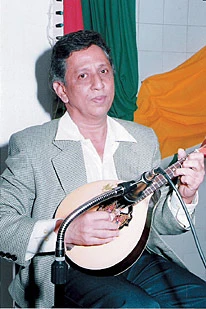
He is gentle and witty. He appears like a figure from a bygone age in his gray jacket, embracing his mandolin. But when Mustafa Sajjad, the international mandolin player from Mumbai, plays, you are almost grateful that he is old fashioned and not carrying a guitar. He plucks his mandolin so delicately, yet with such mastery that a listener is transfixed, overcome by pure pleasure as you drown in a sea of melody. After all he learnt his craft from his father, the renowned mandolin master Sajjad Hussein.
Mustafa Sajjad is also a music director and arranger in the Indian film industry. Many of his compositions like ‘Kabhi to nazar milao’ sung by Adnan Sami (written by Waseem Haider) have been at the top of the charts for months. He has several albums to his credit and his songs are played on Indian satellite channels.
Mustafa Sajjad was in the Eastern Province recently, giving live performances. Of the nine instruments he plays, he loves the mandolin above all;
“My father Sajjad Hussein was a famous Indian music director who composed many hit Indian film songs. He was also a fantastic mandolin player. He had the honor of being the only musician in the world able to play classical Indian music on the mandolin, an almost impossible task because of its limitations. I grew up listening to him and developed a passion for the instrument. The mandolin has eight strings and is very difficult to learn, but under my father’s guidance I mastered the craft at a very early age.”
The Indian film industry welcomed the young Mustafa when he was still in his teens, but already well versed in the complexities of Indian classical music. He soon became an assistant director and worked under the famous music directors, S.D Burman, Kalyanji Anandji and Ravinder Jain. This only enhanced his abilities and soon he was performing in front of live audiences.
“I’ve played in many countries of the world and the response is always the same. People love the mandolin and I play from my heart. The mandolin feels and sounds unlike any other musical instrument.”
The Indian music industry seems to be in a sorry state. Plagiarism is rampant, and there is a deluge of musical videos focusing on scantily-clad models instead of the quality of the music. What does Mustafa think about these trends?
“Plagiarism has always been around. C. Ramchandra was the first Indian music director to introduce Western music in Indian films. But in those days, the directors maintained the Indian touch. Unfortunately today’s music is more noise than melody. The lyrical values have gone. Substandard poetry is matched by equally bad music, and models in a state of semi-undress are the main attraction instead of the music.
Modern technology in sound studios makes everybody think he can be a singer or a music director. Some do not even know music. Many music directors sublet their work and make a fortune. The emphasis has shifted from quality to quantity. Music has become more clinical, and the ethos, the soul is missing. Even the demands of listeners have changed to accommodate this. These are dark times for the music industry.”
Does he have to compromise his art for commercialism? Is he able to stand out from the medley of competitors?
“Yes, I’ve had to make compromises too. But my knowledge of music and training is so sound and strong that I am able to make quality music and sell it too. I have some set rules. I refuse to plagiarize. I usually try to convince the producers by giving them a sample of my music. Sometimes I have to compromise by saying “Okay, I will do four songs of your choice but in return let me compose one of my liking,.” But what he is unable to find in the film industry, Mustafa discovers in live performances. He played for hours in Al-Khobar, and was rewarded with thunderous applause, the audience requesting old Indian songs. “Everywhere I go it’s the same story. People want to hear me play songs that are almost 50 years old. That is testimony to the staying power of traditional Indian music.”
Mustafa Sajjad has worked with an impressive number of Indian singers. He is looking forward to putting one more feather in his cap when, on May 19, he will perform in London’s Albert Hall, playing alongside India’s number one singer, Udit Narayan. “I am a satisfied man, and hope I can live up to my father’s name.”