
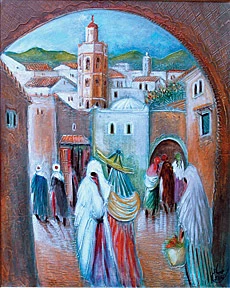
Sbai Mostafa has a mischievous, almost piratical grin and wears his cap at a jaunty angle. He looks like a man you would enjoy haggling with. He probably is, but he is also an accomplished artist, having had shows in Paris, Freiburg, Barcelona and the USA. In 1972, he won the UNESCO Grand Prix for his atmospheric pictures of Moroccan life. Of his paintings, he says, “They’re my children. I paint because I need to, but letting them go is always a sad moment.”
In Jeddah with a touring exhibition of Moroccan art and crafts, he was invited to stage a one-man show. Sbai describes painting as “noble work” “It communicates across borders and cultures,” he says. Without a trace of self-consciousness, he becomes animated when he discusses using the palette knife - his main style of painting. “It’s almost a spiritual experience,” he says. “With the palette knife, I can get a texture, make grand gestures and bold sweeps over the canvas. With it, I can be vigorous in a way impossible with a brush and also fill the space with color.”
The bold relief of the paint on canvas comes to the fore when he paints his favourite theme, the architecture of Morocco. When many Muslims came to Morocco from Spain where they had left their mark on the culture of Andalusia, they brought with them some Spanish influences. “The mix of Islamic and Spanish architecture in Tangier fascinates me,” smiled Sbai, “and I use architecture, especially the arch, as a theme a great deal.”
He spends considerable time researching the old quarter of Tangier, sketching and recording the old buildings. “The customs and traditions of the people are changing; they are all part of Morocco’s history, woven into and expressed through the architecture.” He sees his task as recording the history of Morocco through painted images, using not only the physical shapes of what he sees but also the colours. “The colours of Mediterranean countries are unique - bright, lively and glowing with life, like the people.”
Sbai is in Jeddah as part of the Moroccan Food and Tourism Festival. The country has a long history of tourism and promotes itself as a destination for European travelers. Morocco has a rich mix of cultures that make the Gulf traveller culturally comfortable while offering holiday opportunities influenced by African and European culture.
Home of Ibn Battuta, the widely travelled 14th century Arab scholar who recorded both scientific and sociological observations of cultures other than his own. Tangier is particularly heavy with history but, at the same time, liberally endowed with facilities for visitor. The city has long been coveted for its strategic position where the Atlantic meets the Mediterranean. Carthaginians, Romans, Phoenicians, Vandals, Arabs, Spaniards, Portuguese and the English have jealously fought for the city which was founded in the fourth century BC.
The city has long been an inspiration to artists. The play of color, the bustle in the streets, the clarity of the light and the dazzling whiteness of the houses galvanized the painter Delacroix. In 1832, he wrote to a friend: “Tangier at long last! At this moment I feel like a man who is dreaming and fears that what he sees will escape him”.
No cultural event attempting to give a meaningful view of the country’s atmosphere is complete without examples of the cuisine. And the Council for Regional Tourism in Morocco, has excelled. The tastes and aromas of north Africa are unique and are available every evening. A profusion of dishes, main meals and the Moroccan speciality of diet-wrecking pastries — all are available at the Red Sea Palace Hotel until Friday.