JERUSALEM, 13 May 2004 — A powerful explosion ripped apart an Israeli armored personnel carrier yesterday, reportedly killing five soldiers, in the second such attack by Palestinian fighters in Gaza in two days — as Israel waged its biggest offensive there in nearly a decade.
In all, 11 Israeli soldiers and 13 Palestinians were killed in Gaza fighting Tuesday and yesterday, and more than 175 Palestinians were wounded.
The Israeli deaths reignited an emotional debate over Prime Minister Ariel Sharon’s plan to withdraw Israeli troops and settlers from Gaza, despite a veto by his Likud party and fierce opposition by ultranationalist coalition partners.
The Islamic Jihad group, which has close ties to Lebanese fighters, claimed responsibility for yesterday’s blast, on a patrol road along the Gaza-Egypt border. Israeli commentators said the fighting in Gaza was increasingly reminiscent of Israel’s guerrilla war in Lebanon that ended with a withdrawal in 2000.
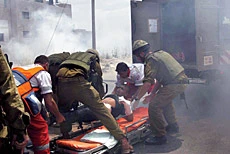
The Gaza conflagration began early Tuesday with a routine army raid in the Zeitun district of Gaza City, with troops searching for weapons workshops. As troops moved out, an armored personnel carrier packed with explosives was torn apart by a roadside bomb. Tuesday’s blast killed six soldiers and scattered their remains across a wide radius.
Israel sent hundreds of soldiers and dozens of tanks into Zeitun in search of remains, some of which had been displayed in the streets by Palestinians.
Troops confined tens of thousands of Palestinians to their homes yesterday and stormed buildings as part of the search. Tanks patrolled streets as helicopters hunting Palestinian gunmen unleashed missiles and machine gun fire. House-sized D9 bulldozers uprooted trees, crushed cars and destroyed parts of the main road and water pipes. Large parts of Gaza City were without water or electricity.
Later yesterday, another armored personnel carrier, also transporting dozens of kilograms of explosives, was blown up near the Rafah refugee camp in southern Gaza, and Arab TV stations monitored in Beirut said five soldiers were killed. The army confirmed casualties, but declined to say whether soldiers had been killed.
The carrier was part of a military convoy traveling on the border road between Egypt and Rafah. Islamic Jihad said it set off the explosion with a homemade missile, while Israeli sources suggested the armored vehicle was blown up by a roadside bomb.
Following the blast, residents of Rafah held up pieces of metal from the vehicle. A smoldering object, apparently the remains of a soldier, lay in a nearby field.
As gunfire crackled in the background, residents, some carrying blankets and mattresses out of their homes, prepared for Israeli reprisals. Israeli helicopters fired two missiles at the camp. No casualties were reported.
Meanwhile, the Palestinian Authority and Egypt urged Palestinians to hand over the remains of the six soldiers killed Tuesday. Defiant Palestinians said there would be no release until Israel pulled its troops out of Gaza City.
Simon Schorno, a spokesman for the International Committee of the Red Cross, said the group was acting as an intermediary. He declined to say whether any progress was made. However, after the second attack on an armored personnel carrier, it appeared unlikely a deal would be struck soon.
Israel said it would not negotiate with the fighters and vowed to continue its operation until it recovers the bodies.
“Anyone who desecrates (the bodies of) soldiers, we shall catch them, and our settling of accounts with them will be bitter and precise,” Israeli Defense Minister Shaul Mofaz told Channel 10 TV.
In yesterday’s fighting in Gaza City, six Palestinians were killed and more than 60, most of them civilians, were wounded. The army controlled a five-square-kilometer area of the city, Palestinians said. Dozens of armored vehicles patrolled deserted streets, snipers took up positions on rooftops and Apache helicopters hovered overhead, firing occasional bursts of gunfire.
— Additional input from agencies