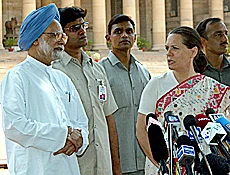
NEW DELHI, 19 May 2004 — Sonia Gandhi’s decision to decline the nomination of her Congress party for the post of prime minister sent shock waves through India yesterday.
The Italian-born politician stepped down despite leading the party to victory in elections, proving to her harshest critics that she had leadership qualities and gaining acceptance as a “foreigner” from millions of Indians. In a day of high drama, Sonia told a late evening meeting of her party’s newly elected MPs that she must “humbly decline this post”, amid vociferous protests.
Whatever the outcome, it will certainly not be a victory for outgoing Prime Minister Atal Behari Vajpayee’s Bharatiya Janata Party (BJP), which along with its right-wing affiliate, the Rashtriya Swayamsevak Sangh (RSS), spearheaded a strident, often crude campaign, against the 57-year-old Sonia.
Sonia has always said she never wanted to be prime minister, and that her main aim was to defeat “divisive forces” like the BJP and form a “secular” government.
“If I had wanted to become prime minister I would have in 1991. That is not the reason I came into politics. It was for the revival of the Congress party. That is supremely important to me,” she said in a pre-election interview.
In the run-up to and throughout the mammoth parliamentary elections, which started April 20 and ended May 10, the BJP and its allies said Sonia was unfit for the premier’s post because she was a foreigner.
Italian by birth, Indian by citizenship and Catholic by faith, Sonia married Rajiv Gandhi and entered the first family of Indian politics in 1968. While Sonia initially refused to join the party, she eventually took charge of the Congress in 1998.
When she wanted to step down as party head a few years ago, protests from Congress leaders forced her back. Many hoped yesterday the same kind of pressure would persuade her to change her mind.
She was elected to Parliament in 1999, and while the party has not performed well under her in the past, it made a dramatic turnaround in these elections and is set to come back to power after nearly a decade.
After the BJP-led alliance conceded defeat on May 13, the campaign against her grew shriller. Yesterday BJP leader and outgoing Health Minister Sushma Swaraj reiterated she would go into mourning the day Sonia was sworn in.
The BJP-led alliance said it would boycott her swearing-in ceremony, and only outgoing Premier Vajpayee would attend.
While teachers, artists and lawyers shouted slogans against Sonia outside the Indian Parliament, a suit was filed in the Supreme Court challenging her possible appointment as premier, arguing it was a threat to national security.
“We are ideologically against any prime minister of foreign origin and we have the fundamental right to protest under a democracy,” BJP spokesman Mukhtar Abbas Naqvi said yesterday. The Congress and its 19 allies — now called the United Progressive Alliance — have 317 seats in the Lok Sabha, far more than the 272-seat majority they need to form the government.
The Congress alone won 145 seats. Some allies, like the leftist parties with 64 seats, decided against joining the government, but pledged outside support. But all unanimously backed Sonia on Sunday as their consensus candidate for prime minister.
On Saturday, when Sonia was elected the Congress parliamentary chief, she said the people’s verdict was a big responsibility and their expectations must be kept in mind.
She told her MPs they should never forget that they owe their positions to the people of India. “At all times, we must act in their interest. At all times we must be conscious of the truth that we are in fact their humble servants.”