
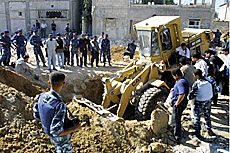
RAFAH, Gaza Strip, 19 May 2004 — Israel calls the southern Gaza Strip town “the largest weapons dump” in the occupied territories. Palestinians and human rights organizations call it a human tragedy, with hundreds of houses destroyed and thousands of people made homeless.
Rafah, the city which abuts the Gaza Strip’s border with Egypt, has become one of the most volatile hotspots in the Palestinian territories since the outbreak of the uprising in September 2000.
Recently, it became the target of Israel’s largest offensive in the Gaza Strip since the beginning of the uprising, as columns of tanks and armored personnel carriers fanned out through the city in a concerted hunt for the operators of tunnels who allegedly used to smuggle weapons into the Strip.
The stakes in the city are high for both sides. Pitted against the army are the tunnel operators, for whom the tunnels represent a major investment — construction costs can reach $120,000 — and the organizations for whom the tunnels are an important supply-line.
Independent Palestinian and Israeli observers say the tunnels comprise a primary source of income for entire families and are also the main source of income in the area. The high profits to be gleaned from smuggling has led to a power struggle between different clans and tribes over who will control the industry.
Caught in the middle, in some cases literally, between the warring Israelis and Palestinian fighters and clansmen, are the residents of Rafah, who since the outbreak of the Palestinian uprising in September 2000 have seen their town take a systematic battering.
The Palestinian Housing Ministry says more than 1,800 homes have been destroyed in the town and its adjacent refugee camp since the uprising began. This is more than half the 3,000 homes Amnesty International says Israel has destroyed in the occupied territories in the past three and a half years.
Some of the homes in Rafah were razed in the anti-tunnel operations, some were demolished as the Israelis widened the so-called “Philadelphi” buffer road along the border, which they patrol and control.
The end result, say officials from the United Nations Relief and Works Agency, is more than 12,000 people of the 167,000 population made homeless in total. If above the ground the scene is one of destruction, the scene underground is one of feverish construction as diggers determinedly burrow their way under the border.
Majid (not his real name) who admits he belongs to one of the tunnel operation organizations, told Deutsche Presse-Agentur that it takes up to three months from the time a tunnel route is agreed on until the time the first contraband makes its way through it.
Digging is done mainly by young men, who earn $200 per cubic meter excavated. The shaft can be sunk in the basement of the house, or in a shed outside it. Some have even been dug from bedrooms and kitchens.
Over time, as the diggers grew more expert, both in excavating and avoiding Israeli countertunnel measures, the tunnels themselves have become more sophisticated.
Now about one meter square, they contain electric lighting piped in from the house above, oxygen bottles and even a “railway” — iron railings on which runs a small wagon.
But the high-investments are lavishly recouped once the tunnel goes operational. Although the tunnel owners can also be the smugglers, they usually hire the tunnel out. Prices are negotiable and depend on the type of goods the smugglers intend bringing in.
The tunnel operators say their main activity is bringing commercial goods into the Gaza Strip. They are forced to use tunnels for this, they say, since the border is closed.
Israel says the tunnels are a “major threat”, through which Palestinians have smuggled in arms.
The anti-tunnel raids are no guarantee new tunnels will not be started once the troops leave. And although security officials have said Israel will widen the border buffer zone to up to one kilometer and demolish hundreds of more homes in the process, pushing inhabited Rafah further and further back has simply ensured that the tunnels have to be longer.
“If we have to, we can start a tunnel in Khan Yunis,” Majid told DPA, referring to the Palestinian city which lies about five kilometers from the border.