
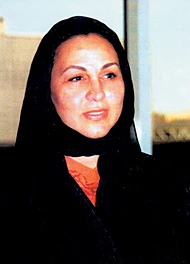
JEDDAH, 21 May 2004 — With “Middle Eastern Baroque” still the dominant style in well-to-do homes in the region, Moodhy Khoja has struck out alongside a few others to bring the magnificent but largely neglected Arab heritage back into local interiors.
With one store in Jeddah and another in Dubai, she has also furnished homes as far afield as Spain and Switzerland. Passionate about antiques and an inveterate traveler, she is on a mission to remind the people of the Middle East of the highly sophisticated arts and crafts that were once produced in abundance right on their doorstep.
Yet nothing in her early training suggested she would end up as an interior designer. She has a B.B.A. from King Abdul Aziz University in Jeddah. She got married at an early age to Saeed Amin, the deputy director of the Civil Aviation Commission and director of airport projects. “I only really started after my children had grown up,” Moodhy says. “I wanted to start a project that I could learn and benefit from, not for mere financial gain.”
Now she trades in classical furniture “because I love to collect valuable original pieces.”
“I consider myself to be committed to the Islamic heritage which bears the traces of European influences — such as the furniture of Spain and Turkey. I travel a lot between big museums and historical sites in England, France or even the US.”
When Khoja visits museums, she is on the lookout for any piece that fits in with her passion for Islamic art. “Antiques are always fascinating,” she says. “Islamic libraries, delicate wood-carvings attract me; but besides Islamic décor I also love the Roman style.”
This is also reflected in her work, where Roman influences can add a touch of the unusual.
Khoja also loves nature. “Air, water, and earth are important to me. I love wooden pieces and everything that is related to the earth.” Her favorite color is red. “I love red with all its shades, as well as yellow and brown, especially in different kinds of wood.
In her work she is determinedly low-tech, avoiding anything mass-produced and championing the handcrafted. Unless it’s essential, she says, she likes to avoid modern technology.
Yet she is forever jet setting to keep abreast of the wealth of ideas on the international market. “I make sure I visit international exhibitions for home furnishings. I also attend big auctions, and I go to museums and visit historical sites all over the world.”
Now Khoja’s daughter Ghazal, who has a keen eye and studied interior design and décor, has joined her, giving her a chance to expand the business.
In the beginning, Khoja relied on the help of a friend to show her the ropes in the business. “My husband also contributed a lot and supported my work. Sometimes my children complain because they want me to stay at home, but my husband always revives my courage, and it’s because of him that I have the chance to travel and explore.”
Business comes from a number of prominent women, who have been championing her work since she started out. In Jeddah she works by appointment with her customers, while her daughter Mahaba looks after the branch in Dubai while completing her studies in Sharjah.
So are four years in the business enough to teach her everything there is to know?
“I don’t think so. But I’ve been at it much longer because my husband used to travel around the world a lot, and that meant I furnished and supervised the building of houses in Riyadh, in Syria, and in Switzerland and Spain as well. There is where I first dealt with architects and learned from their expertise
“I learned about everything: heating, air conditioning, and how to arrange furniture in rooms to maximum effect. I am learning all the time.”
There were big and small difficulties in first getting set up in business, but nothing Khoja was unable to overcome.
Theft of ideas is something that troubles her, but she is learning to look at imitation as the sincerest form of flattery.