
It is not the Victoria & Albert, the Smithsonian, the Louvre, Topkapi or the Salar Jung. It is not as big nor does it contain as much but in terms of its exhibits, it is without equal. Its items are so valuable that no price can be put on even the smallest of them.
In the hills near Makkah, not far from the Kiswa factory, is the Museum of the Two Holy Mosques Architecture. Its manager, Abdul Mohsen Abdul Rahman ibn Humaid, said it was established in 1999 by Prince Abdul Majeed, governor of Makkah, at a cost of more than SR15 million. In addition, there are photographs worth some SR10 million which were a gift from Prince Sultan, second deputy prime minister, minister of defense and aviation.
The museum is open every day except Thursday and Friday from 8:00 a.m. to 2:30 p.m. and from 4:00 p.m. to 10:00 p.m. During Haj, it is open every day including Thursday and Friday. In addition to school and college students, more than 200,000 people coming from abroad for Haj and Umrah have visited it.
In 1988 the Custodian of the Two Holy Mosques King Fahd laid the foundation for the third Saudi expansion of the Grand Mosque in Makkah. Three years earlier, an equally ambitious plan had been launched at the Prophet’s Mosque in Madinah. Both can now accommodate more than one million pilgrims. A notable feature of both projects is that all expansions have been done in a way which allowed for future extensions without disturbing the architecture, style or appearance.
Many of the items were replaced during the various expansions, renovations, and changes, form part of the museum’s permanent collection.
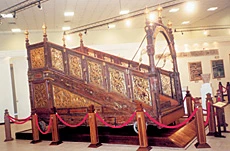
The museum is divided into seven sections. As one enters, on the left is a model of the Holy Mosque in Makkah and huge photographs of the Makkah and Madinah Harams on the walls. Just a few feet away is an imposing masterpiece, the wooden staircase of the Holy Ka’aba, made in 1825. In an old photograph, one can see it behind the Zamzam building. Just a few steps to the right from the staircase is the museum’s oldest piece — the brass head of the pulpit made in the era of Sultan Sulaiman Al Qanun.
The Ka’aba section has one of the columns of the Ka’aba constructed by Abdullah Ibn Az-Zubair in 65H (685G).
The library section contains rare copies of the Qur’an and manuscripts.
In the Zamzam section are displayed the old railing of the Zamzam well with a brass bucket (1882) which was used to draw water and an old pulley. Other pieces include the case which was used to cover the Maqaam Ibrahim (Station of Ibrahim) before its replacement in the reign of Custodian of the Two Holy Mosques King Fahd, two brass crescents of a minaret of the Holy Mosque (1882), a marble arch façade of one of the doors to the Holy Mosque (1576), a copper-plated leaf of a door from the pulpit of Sultan Sulaiman bin Salim in the Holy Mosque, which he ordered to be made in 1559, a copper door of the Holy Mosque dating back to the first Saudi expansion, a wooden door from the Holy Mosque dating back to the early years of the 14th century Hijra, and a copper pillar which was one of the pillars around the mataf dating from the first Saudi expansion of the Holy Mosque.
Also on view is the door of the Holy Ka’aba (1944), ordered by King Abdul Aziz in addition to the door of the Holy Ka’aba (1636) made in the era of Sultan Murad, one of the pillars of the Holy Ka’aba with its wooden base and crown dating from the construction by Abdullah ibn Az-Zubair (685), a rocky base that held the pillar, one of the doors of the Prophet’s Mosque from the reign of King Abdul Aziz, a brass crescent (1882), the crescent of the main minaret from the Prophet’s Mosque from the early 14th century Hijra, and a copper grille formerly on one of the windows of the Prophet’s Mosque dating from the Saudi Era.
A beautiful intricately carved gypsum window of the Prophet’s Mosque has been imaginatively exhibited with a photograph below showing it tilted. One can see the inscription on marble marking the date of the construction of the door and the parts of the Holy Mosque that were damaged by fire during the reign of the Mamluk Sultan An-Nasir Faraj Bin Bargog (1402), the inscription on stone recording the contributions of the Mamluk Sultan Abu Sa’iid Jaqmaq (1448), a marble slab on which is engraved the name of the Ottoman Sultan Murad (1575), and the rain gutter of the Holy Ka’aba made of wood and plated with gold on the outside and lead inside (1857).