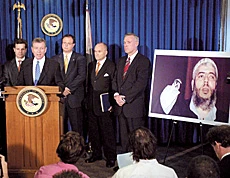
LONDON, 28 May 2004 — Britain arrested radical cleric Abu Hamza Al-Masri in a pre-dawn raid yesterday after the United States sought his extradition on charges of hostage-taking and supporting Al-Qaeda.
An 11-count indictment filed by US prosecutors accused him of hostage-taking in a 1998 attack in Yemen that resulted in the deaths of four hostages. Under US law he could face the death penalty.
When asked in a London court if he was willing to go to the United States, Abu Hamza smiled, shook his head and said: “No.”
Abu Hamza was remanded in custody after bail was refused and will appear in court again on July 23.
In the United States, hostage-taking can carry the death penalty and this could complicate extradition from Britain where capital punishment was abolished 35 years ago.
By law, Home Secretary David Blunkett cannot allow extradition without assurances the death penalty will not apply.
But Blunkett said Britain had received such assurances in general terms from Washington. “We have an agreement with the US, which I reaffirmed a year ago, that the death penalty would not be put in place,” he told BBC radio.
Abu Hamza, 47, who preaches jihad and openly admires Al-Qaeda leader Osama Bin Laden, faces up to 100 years in prison over the charges.
His arrest occurred as Britain itself was considering detaining Abu Hamza, a hate figure for British tabloids, who has one eye and a steel hook in place of his right hand after being wounded fighting in Afghanistan.
The Crown Prosecution Service said the Americans had effectively acted first.
“The position as of yesterday is that we were considering some material that the police had sent to us and were looking to see if there were grounds on which charges could have been brought,” a spokeswoman said.
Security sources said British police had been studying the possibility of bringing charges of incitement to violence after the preacher applauded the September 11, 2001 attacks on New York and Washington.
He was stripped of his British nationality a year ago on allegations of supporting terrorism, becoming the first person to have his citizenship revoked after new measures to deport immigrants whose words or actions were deemed to “seriously prejudice” British interests.
Last month, he won nine more months to appeal against the nationality decision. He denies any formal links to Al-Qaeda.
Yemen, where Abu Hamza’s son has served time in prison on terrorism charges, has long sought his extradition over the 1998 attack. Britain has said it has no extradition treaty with Yemen.
After moving to Britain years ago and working as a doorman at London discos, Abu Hamza went to Afghanistan in the 1980s to help the Mujahedeen fight Soviet occupation troops. He lost both his forearms and an eye to an explosive device in that conflict.
In the 1990s, he returned to Britain to preach radical Islam in London mosques.
He was shut out of his north London Finsbury Park mosque in January 2003 but simply switched to preaching on the street outside.