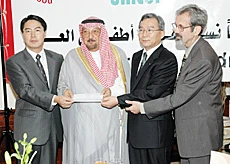
JEDDAH, 9 June 2004 — At an informal low-key ceremony on Monday, Stefan Toma, the United Nations Children’s Fund (UNICEF) representative for the Middle East, received a check for SR330,000 from LG Electronics and its Saudi partner United Yousef M. Naghi Co. Ltd.
“The cash is to help UNICEF’s work that affects the lives of Iraqi children,” said C.K. Cho, general manager for LG Saudi Arabia. “I believe children have no politics, commercial or social agendas; they are simply children. The response from the Saudi public at the chance to help in this way has been very moving,” he said.
“It is essential that we contribute to the future of nations,” echoed H.K. Seo, managing director of United Naghi, LG Division. “As either individuals or as a company that is part of the community, it is the most important thing we can do.”
“The money was raised by LG from the Saudi public through a campaign that promised a SR10 donation from the company from certain purchases over the campaign period,” Deputy General Manager S.M. Arshad said. “Setting up the campaign involved considerable groundwork and negotiations with UNICEF’s Riyadh office and United Naghi. Both parties had to be sure it was conducted with the strictest probity.”
Dr. Nizar Samman, who acts as senior advisor to UNICEF in the region, said that he believed that the children of today were the leaders of tomorrow. “If we are working to help children, especially those in Iraq, then we are engaged in noble work,” he said. Anyone who has been involved — donating, collecting or distributing — has been touched by this charity.”
Stefan Toma said UNICEF’s work often went unpublicized. “We are working in Iraq now. In fact we never left,” he said, referring to the fact that the organization was working with children there during Saddam’s regime and throughout the Iraq war. He said despite the relocation of international staff and difficulties that hindered the national staff movement, UNICEF continued to provide humanitarian assistance in cooperation with the Iraqi authorities. “Since the beginning of the year,” he said, “We have spent over $8 million a month on our projects for children in Iraq.”
He said one of the main focus of the work is the rehabilitation of Iraq’s schools. “Already we have refurbished 220,” he said, “but it will be a huge task. There are 18,000 schools in the country.” To address the immediate problems of getting children back to school, UNICEF has devised the “school-in-a-box” program.
“There is a chronic shortage of the simplest school materials,” Toma explained. “So we have provided a box containing basic materials for learning — paper, pencils and such things — so at last they can begin learning again.”
UNICEF is not just an emergency response organization. It has no political agenda — in the same way as the Red Crescent or Red Cross have none. Currently UNICEF in Saudi Arabia is laying the groundwork with the appropriate ministries to begin a program to reconnect the children of “overstayers” with their parents. “The facilities in the shelters here in Saudi Arabia are wonderful,” he said, “but I always see a sadness in the children left behind, either when their parents return to their country or disappear.”