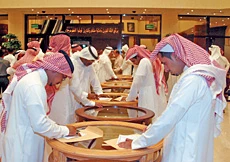
JEDDAH, 9 June 2004 — Hundreds of journalists took part in elections for the Saudi Journalists Association, the first of their kind in the Kingdom, in Riyadh on Monday.
The board of the SJA includes two women. The members also endorsed the association’s basic law, with 200 members voting for the law and four against; 114 members expressed reservations and two abstained.
Culture and Information Minister Dr. Fouad Al-Farsy congratulated the newly elected members, and expressed his hope that the board would play a constructive role promoting journalism in the Kingdom.
“The ministry is ready to cooperate with the association to realize the hopes and aspirations of all journalists,” Al-Farsy said. He said the ministry had given full powers to the founding committee to set out the association’s basic law.
“We have also approved all elected board members and have not appointed anyone on the board; we have confidence in the SJA’s general assembly,” the minister said.
Initially, the Ministry of Information and Culture had decided to appoint three of the nine members, but Monday’s election makes the SJA the first association with a fully elected board.
Since the announcement of elections for the board in January, the electoral process has met with a slew of obstacles regarding procedure, nominations and voting methods. They were postponed twice to accommodate recommendations and criticisms raised. A final list of 31 nominees, including five women, was published last week. However, journalists had to travel to Riyadh to cast their ballots or officially delegate a colleague to vote on their behalf.
Security was tight at the Saud Al-Babtain Center for Heritage and Culture where the event took place and the voting process organized and calm.
“This is a historic day for Saudi journalists and local journalism,” said Turki Al-Sudairi, speaking on behalf of the association.
Nahed Bashatah, one of the successful women nominees, told Arab News the atmosphere in the women’s section was cordial. Around 30 female journalists attended the event. “This is a good number considering that it’s the first time,” she said. “I think the process was fair and organized, although the delays disappointed some people and caused some distrust of the organizers.”
The first order of business for the board is to elect the president, vice president and treasurer. For Bashatah, priority issues she intends to raise for discussion are full-time employment of women in the media, contracts, training and job security.
“I want to improve the stereotypical image not only of Saudi women but Arab women in general, whose contributions and role are not appreciated,” she said.
Al-Sudairi suggested limiting members to two terms of three years each. “I think that is a good idea, it allows new blood to emerge and opportunities for others,” Bashatah said.
She said she was happy that women were elected. “This supports women’s expectations and contributions in the decision-making process.”
Not everyone was equally positive. Nabila Mahjoob, an unsuccessful candidate, said most of the nominees were editors in chief — five out of nine — which she said defeated the purpose of protecting journalists’ rights. She also criticized the fact that many candidates had been disqualified despite meeting all the criteria.
Mahjoob also felt robbed of the chance to experience the anticipation and the process of counting the votes and knowing the results in reasonable time.
“Even though many of us had to fly to Riyadh and bear the time and expense of the trip, we were not shown the courtesy of being told the results before we had to fly back to Jeddah — I still don’t know how many votes I got,” Mahjoob told Arab News.
However, she said this was a new experience and part of a learning process. “I feel that I have succeeded, whatever the outcome, because I gained from this experience and had the chance to meet many colleagues.”
Results at a Glance
The highest number of votes (246 out of 317) went to Turki Al-Sudairi, editor in chief of Al-Riyadh Arabic daily. The two women board members, Nawal Al-Rashed and Nahed Bashatah, received 167 and 121 votes respectively.
The other six elected members of the board are: Abdulwahab Al-Faiz, editor in chief of Al-Eqtisadiah (218 votes), Khaled Al-Malek, editor in chief of Al-Jazirah (198), Qenan Al-Ghamdi, former editor in chief of Al-Watan (196); Muhammad Al-Wael, editor in chief of Al-Yaum (157), Ali Hassoon, editor in chief of Al-Bilad (124) and Abdul Aziz Al-Nahari, deputy editor in chief of Okaz (120).