
Since the early days of Islam, Muslim women have involved themselves in creating beautiful interior designs and attractive exteriors unique to Islamic society and culture. "As men are endowed with natural abilities and skills which have influenced their roles and contributions, so are women also endowed with complementary abilities and skills," said Mrs. Afaf Badran, an architect and interior design consultant who has been in Saudi Arabia for nineteen years. She explains that most women are observant, aware of details, possess imagination and exhibit concerns about the needs, safety and health of their families.
These traits, in addition to their resourcefulness, creativity and fondness for beauty and an environment that pleases the senses, make many women into talented designers. Mrs. Badran has worked on educational programs intended to foster creativity in women and promote their talents and skills in developing and enhancing their environment. The programs have been commended by the Secretary General of the Aga Khan Awards. Apart from teaching interior architecture students, Mrs. Badran lectures about Muslim art and architecture in different establishments, focusing on the expression of beauty, the values and ethics.
The essence of Muslim domestic architecture is privacy: keeping the family and its women secure in their private world, away from the house's public rooms and the eyes of the public.
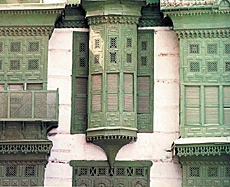
The outer facades of houses were traditionally designed with a small number of windows well above the floor. The windows were placed deep into the thick walls or were covered from outside by a variety of wooden screens. While these shutters and rawasheen helped shield the interiors from the heat, their primary function was to maintain the privacy of the inhabitants while at the same time admitting natural light and air. Men and women traditionally had separate areas for their guests but of course shared the same family rooms. The hospitality and generosity of Muslims was reflected in the large living rooms of their houses where there was usually also an annex or a suite for guests. Houses were built around an internal courtyard shielded from the street by a high solid wall or thick high vegetation. Houses were supposed to look plain from the outside but respectable.
Neither grandeur nor extravagance was encouraged in the exterior while comfort and beauty were encouraged within. "Muslim art is so similar in spirit throughout the Muslim world, yet exciting in its aesthetic value and its sublime appeal of beauty and peace. There is diversity within unity," commented Mrs. Badran.
Today in the Muslim world, there are a fair number of women architects and designers. Mrs. Badran has been a practicing architect for twenty four years, nineteen of them in the Kingdom. Through her travels and her work, she has met women architects from Morocco, Egypt, Yemen, Iraq, Jordan, Syria, Iran, Pakistan, Indonesia and Saudi Arabia. "I recently met two professional Saudi women designers who have been practicing for fifteen years or more."
Increasing attention is being given to Saudi women as designers and architects. Several have studied abroad or graduated from the college of interior architecture and design at King Faisal University in Dammam. Recently, Dar Al-Hekma College in Jeddah and Prince Sultan University in Riyadh began offering a degree in interior design and a new Saudi magazine, Al-Manzil (House) for architecture and design has sought the contributions and views of professional Saudi women such as Fatin Al-Maddah, Lubna Jamjoom and Amal Al-Rouaie.
Women's contributions and their differences from men are seen in their approach to space, buildings and furniture. According to Badran, women architects, planners and designers may be more understanding and conscious of addressing design requirements for emergency exits — for example, staircases and conveniences for pregnant women, children and the elderly. "Many male architects have a tendency to design a building as a landmark and then work to fit in the interiors. Women designers, on the other hand, tend to design from the inside out."
Even in the desert, Bedouin women actively contributed to the creation of soft and simple architecture. In Yemen and Asir in southern Saudi Arabia, women contribute to building, rendering and painting their houses, according to Badran. In Egyptian villages, women assist in building and actually shaping, organizing, decorating and even maintaining their houses. In squatter settlements or informal developments that occur after natural disasters, wars or other socioeconomic reasons, the effectiveness of these developments is based on the substantial roles of women. "Unfortunately, the role and contributions of women have rarely been documented," said Badran. Even in western countries, the role of women as architects is not often publicized, she asserts. Architecture and design are careers that require a full time commitment and women architects and designers are confronted with the challenge of choosing between a demanding career or dedication to their families or a struggle to balance the two.