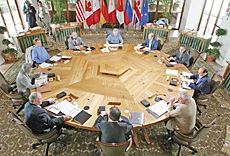
SEA ISLAND, Georgia, 10 June 2004 — The United States and France clashed again over Iraq yesterday, sparring over NATO’s role in the occupation, one day after soothing their dispute on post-war strategy with a new UN resolution.
Diplomatic hostilities reignited at the Group of Eight Summit, after President George W. Bush, emboldened by the Security Council green light for his bid to remake Iraq, went on the offensive, calling for a greater NATO presence in the country.
“We will work with our NATO friends to at least continue the role that now exists and hopefully expand it somewhat,” Bush told reporters after huddling for breakfast with top war ally, British Prime Minister Tony Blair.
Facing a knife-edge re-election battle, Bush wants to ease the plight of US troops, many of whom are reservists or on extended tours as they battle a vicious resistance.
But French President Jacques Chirac, reprising his role as Bush’s chief antagonist over the Iraq invasion last year, erected an immediate rhetorical roadblock on the highly secured private island hosting the summit.
“I do not think that it is NATO’s job to intervene in Iraq,” Chirac said.
“Moreover, I do not have the feeling that it would be either timely or necessarily well understood,” said Chirac. “I see myself with strong reservations on this initiative.”
Although the United States, Britain and other NATO members have troops in Iraq, the alliance has no real formal role in the country, and some NATO members like Canada, France and Germany have declined to send troops.
The clash overshadowed a display of unity put on by smiling leaders, zipping to talks at a plush east coast resort in high-tech golf buggies.
Discord also surfaced over the issue of Iraq’s mountainous debt, with European states resisting US calls to quickly forgive almost all of it.
A French official, who asked not to be named, said the G-8 had agreed to forgive a “substantial” part of Iraq’s 120-billion-dollar debt but had not set a precise figure.
The United States is pushing for up to 90 percent to be canceled but countries like France, Russia and Canada are unwilling to go so far.
Russian President Vladimir Putin is ready to cancel 65 percent of the Iraqi debt and is also linking the move to the ability of his country’s businesses to operate in Iraq, a Russian official said.
He quoted Putin as telling Bush that “our flexibility will depend on yours and the capacity of our businesses to work in Iraq.”
New sparring over Iraq emerged as Bush prepared to introduce the country’s Iraqi interim President Ghazi Al-Yawar to the world stage.
A day after the Security Council voted to return Iraqi sovereignty but to permit US troops to stay on, Bush was also due to hold one-on-one talks with Yawar.
Despite the discord, the summit did deliver early on the trade front, as G-8 leaders vowed to revive stalled World Trade Organization talks “promptly,” according to Japanese officials.
Bush also tried to prevent his watered down plans for a social, political and economic shakedown of the Middle East and northern Africa from fizzling out completely.
Europe has signaled it believes threats to the West from the Middle East can best be eased by first draining the Israeli-Palestinian bloodbath.
The White House is pushing a “Broader Middle East and North Africa Initiative” to promote political, social and economic reforms, and has rejected calls to shelve the strategy until the Israeli-Palestinian conflict cools.
But European Commission chief Romano Prodi warned Tuesday that “the mother of all conflicts is the Israeli-Palestinian conflict,” arguing only peace in the Middle East would spur reform and Western oriented policies in the region.
European Union officials said that any US focus on the region was welcome, but diplomatic adviser to the European Commission Stefano Sanino said Europe had been working on the same lines for years.