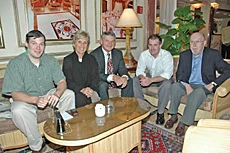
JEDDAH, 17 June 2004 — After a 10-day fact-finding visit to Saudi Arabia, a small group of US visitors will take away some conflicting images of the country. The visitors, all involved in gathering and disseminating knowledge of international affairs, met with government and business leaders and collected a mixed bag of impressions.
All agreed that the general public in the US was largely uninformed about the Middle East. “The average Joe doesn’t have the time in his day to deal with the intricacies of some of these issues,” said Gregory Hilton of the South Carolina Export Consortium, a research organization concerned with trade. “We as a group are relatively well-educated but we didn’t really know what to expect.”
Most of the group are members of the World Affairs Council, a non-profit organization of some 80,000 members, dedicated to disseminating information about cultures and traditions around the world to the US public. Through a series of education programs in schools and public meetings, they reach over two million members of the public annually.
“People don’t think about the Middle East unless it is in the headlines,” said Wat Cluverius, president of the Cleveland Council on World Affairs and a former diplomat with long experience of the Middle East and the Kingdom.
Cluverius identified some of the huge changes since he first visited Saudi Arabia in the 1960’s. “There is a lively national dialogue, completely unheard of a decade or two ago,” he said. “I see now an optimism among the many professional women, even the fact that there are professional women meeting with a foreign delegation. They were kind of bubbly about the prospects for the future.”
However he pointed out that he picked up a certain sense of denial about events in Alkhobar — both recently and years ago. “There’s an idea that ‘This is all foreigners’ and this is really just random thuggery rather than carefully planned operations that lead to attacks.”
He felt this unrealistic. “They are being targeted by people who know what they are doing,” he said.
William Wheelock, president of the Florida Palm Beaches World Affairs Council, identified a sense of stress between traditional values and “where Saudi Arabia is trying to go and the place that religion occupies within that place.”
He felt that a major challenge facing society was to embrace changes in technology without being taken over by it while maintaining its religious and cultural identity.
“There is a need for exchange on both sides of the fence in order to understand one another,” said Wheelock. “It’s true for any group including Americans — if you never say that there is anything wrong, you lose your credibility and therefore you lose the battle. If speakers with Saudi backgrounds don’t tell you about what is bothering them, the audience will not believe the other message either. It just becomes propaganda.”
Judy Wheelock, who acts as school programs director, was surprised at just how many people dislike President Bush.
“We have seen his popularity go down in the US but to hear people round the world have such negative feelings is a surprise. Hearing people here talk about him being the cause of the war in Iraq and that the US is at fault really jolted me,” said Judy.
Gregory Hilton, who at 27 was the youngest member of the group, found the younger Saudis he met displayed a sense of confusion. “I can identify with these people but I was shocked at the sense of confusion among the young people. They seem not to like the input from the US, yet they buy the goods. They express dislike at modern society, yet at the same time they don’t like the traditional ways of doing things.”
“It’s up to those in power now to make the right decisions — but a lot of the impetus is going to come from the younger generation as they become more techno-savvy,” he said.