
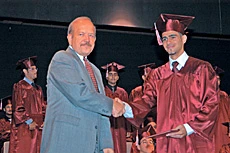
DHAHRAN, 18 June 2004 — The 2003-2004 school year has finally concluded for most of the Kingdom’s youngsters. Bombings, checkpoints and midtown shootouts all added up to create a challenging backdrop against which schools were supposed to operate “normally” — not that anyone can define what normal is in Saudi Arabia anymore. Without a doubt school administrators across Saudi Arabia let out a sigh of relief when the last of their charges were sent home safely for a bit of summer vacation fun. The relief was brief however and worries are already surfacing about what August will bring.
W. Fred Bowen, superintendent of the Kingdom’s International Schools Group (ISG), will try to keep those concerns on the backburner as he leaves this week for some well earned R&R. ISG operates eight schools based in Dhahran, Dammam, Abqaiq, Jubail and Yanbu, all running on either British, American or international curricula. ISG began in the Kingdom in 1962 and has no government or military affiliation.
“We operate as a school district licensed under the Ministry of Education and that’s who we report to and no one else,” Bowen said. “ISG runs on a non-profit basis with 80 percent of our costs going for salaries. We are accredited by American and international organizations simply to provide us with external evaluation and validation that our schools and the work that we do is high level and high quality — suitable for the needs of students in the world today.”
A native of Montana, USA, Bowen had considerable learning, teaching and administrative experiences in such diverse locations as Canada, Germany and Russia. He came to Saudi Arabia with his wife and two children in 1998 to take up the position of principal at Yanbu International School. But even he admits that nothing has prepared him for the current climate of violence and fear which has beset the Kingdom.
“I am an educator,” Bowen said. “No one prepared me, not in university, not in graduate school, for dealing with issues of security to the levels that we’ve had to. It has brought a dimension to this job that is totally different than I ever expected. I don’t profess to be an expert nor to be well versed in how to deal with security. What I have done though is to depend on my board of trustees and on the opinions of people I respect, to try and do what is most appropriate. Even in Moscow, where I was the principal of the Anglo-American School, we had the occasional bombing while I was there. We had riots in the streets and we had gunfire occasionally, but we never felt the school was insecure or the children were unsafe. So my experiences accumulated over four years there are quite different from what I am doing now.”
Bowen became superintendent of ISG at a time when the organization began facing many challenges. Three years ago enrollment at ISG was 3,300 students. For the coming academic year Bowen has budgeted for 2,500. There’s been about a 10 percent annual decrease. Bowen links the declining Western enrollment to a variety of factors including Saudization, hiring of Subcontinent engineers in the oil and gas business and now the security issues. The erosion of the student body has been a cause for concern but three months back government authorities and business leaders in the Kingdom’s industrial cities advised Bowen that they expected a significant upsurge in the number of Western companies coming to Saudi Arabia. What will happen now though is uncertain.
“I have been in meetings for the past week with the Royal Commission in Jubail and by proxy in Yanbu as well, talking about the need to keep the Western schools in those locations. It is very important to them,” said Bowen. “The Royal Commission did not hesitate this week to say, ‘We want to do whatever we have to do to help you keep your schools viable.’ They want the schools in those communities because they believe they will not get Western investment if there is nowhere for (expatriate) children to receive high quality education.”
ISG has been able to recruit new staff for the coming school year and even after the recent attacks only three of the district’s current staff members resigned. But Bowen looked almost pained when asked how he was handling the issues facing all residents of Saudi Arabia.
“I wish I could say I am handling them, because I don’t feel that I am in control by any means,” he said. “Some of our parents have decided to leave for obvious reasons. That kind of anxiety and skittishness and concern of course moves on to our teachers. Most of our staff have left on vacation and most of them are saying, ‘We’ll see.’ The parents are also saying, ‘We’ll see.’ Many of our parents however have taken steps to get all of their children’s papers and records in case they determine that they are not coming back. So far, we have not had the same experience with our staff, with the exception of those three that I mentioned.
“However, and this is almost pessimistic, my reality sense tells me that we will probably lose some teachers this summer. In particular, if the targeting of Westerners continues in Saudi Arabia. Many of our sponsored teaching couples are families with little children and quite honestly they just feel like they can’t bring their children into this. Our concerns relative to August are No. 1, ‘Will we have students?’ No. 2, ‘Will we have staff enough to teach?’ We can’t do much until August when we see what is happening.”
The bottom line is ISG is soldiering on. Even after the attacks in Alkhobar, ISG’s Dhahran schools only closed for two days and then it was back to work as usual. The priority for ISG is to keep its students safe.
“We would not be operating unless we believed that the children could come to school and be safe,” Bowen said. “Last year after the May 12 bombing ISG closed all its schools and shortened the school year. That was because the situation was such an unknown at that time. We didn’t know what was going on and what were the implications of the bombing. We couldn’t guarantee reasonable safety and so we closed. Later, we felt that the closure was a mistake. There are a lot of students in our schools for whom home is Saudi Arabia. They aren’t going to evacuate to another country or go somewhere. They are home. Because of that we feel strongly that we must be up and operating if possible. It is essential to keep normalcy in our students’ lives.”
Can ISG guarantee the safety of the students they serve? Bowen didn’t hesitate for even a second before answering: “No, we can’t. In the end if sick minds out there decide that they want to go after children, I guess they will. And when that happens that will be the end of ISG because we would not operate under those circumstances. As of now we are opening in August as we normally would. Our people are coming back. We’ll see what that means.”