ISLAMABAD, 19 June 2004 — Nek Mohammad, the long-haired rebel tribesman and former Taleban commander who defied Pakistan’s campaign to drive Al-Qaeda from its tribal belt, was being publicly embraced by generals just two months ago.
Yet yesterday the military proclaimed major success in tracking, targeting and killing him, in a precision nighttime strike on a mud-walled compound in the remote district of South Waziristan on the Afghan-Pakistani frontier.
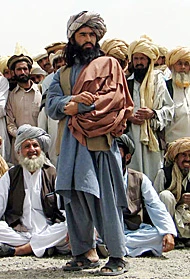
Yesterday morning thousands of tribesmen converged on Mohammad’s dusty home village of Kaloosha, some 10 kilometers from the outskirts of Wana where he was killed on Thursday night.
The funeral ceremony was silent, residents said, devoid of customary speeches, and most of the stunned tribesmen had come to see whether the diehard warrior really was dead.
With his flowing dark locks, long black beard and a Taleban-style turban, the swaggering tribesman in his late 20s had cultivated a heroic image among the largely anti-American Pashtun tribes straddling the Afghan-Pakistani frontier after leading a bloody resistance to the army’s largest ever Al-Qaeda offensive in March.
He claimed victory after the army withdrew, suffering 46 troop deaths, and offered him amnesty.
“The world knows who has really surrendered,” Mohammad declared before thousands of tribesmen after a government ceremony on April 24 to formally grant him amnesty, in return for laying down arms and helping to register hundreds of foreign fighters.
Regional army commanders embraced Mohammad at the ceremony and garlanded him with flowers.
Until then Mohammad had topped a government wanted list for harboring Al-Qaeda fugitives. He was a chief target of the bloody March offensive, but led fierce resistance which resulted in the army’s worst ever casualty toll since joining the US-led war on terrorism.
Mohammad was from the fierce Yargulkhel clan, an offshoot of the battle-hardened Waziri tribe which was famous during British colonial rule for constantly attacking British troops. The Yargulkhels have long defied authority.
“Nek Mohammad is seen as David defeating the Goliath of the US and Pakistani army,” said Peshawar-based commentator Iftikhar Ali in April.
“The people have a lot of respect for him. He is a hero for struggling against America.”
Mohammad’s links with Al-Qaeda fighters went back to Taleban-ruled Afghanistan, when he was a commander for the hard-line Islamic militia near Kabul, regional experts said. He trained central Asian fighters — Chechens and Uzbeks — who had found sanctuary in Afghanistan from their own regimes in Afghanistan under the Taleban’s 1996-2001 rule. “That’s where he gained a massive following of Central Asians,” said a veteran Pakistani reporter on the tribal regions. “He was one of the most popular Taleban commanders.”
After the Taleban regime collapsed, he returned home to Kaloosha and set up sanctuaries for other Central Asian fighters fleeing US-led bombing, said Professor Sarfaraz Khan, a Central Asian expert at Peshawar University.
Western diplomats say Mohammad had been supplying arms and tribesmen to Al-Qaeda-linked fighters for cross-border attacks in Afghanistan on aid workers, troops and government targets. “He is, indirectly or directly, responsible for the deaths of up to 400 people in Afghanistan,” a Western diplomat based in Pakistan told AFP on condition of anonymity. As more clashes erupted between the army and militants in recent months, Mohammad’s hero status waned as residents grew weary of fighting. “If this means war is over, then we are happy,” tribesman Mohammad Ullah told AFP.
“We’ve been living under curfew and feeling like prisoners because of constant exchanges of fire. The bazaars were closed, transport charges hit the sky, the price of tomatoes doubled,” resident Naeem Wazir said. “Who knows what will be the repercussion of Nek’s death, but we are happy that our children will live in peace.”