JEDDAH, 25 June 2004 — Saudi Arabia could allow foreigners who feel threatened by the wave of terrorist violence in the Kingdom to carry guns for their protection, Interior Minister Prince Naif said, as the first terror suspect under a month-long amnesty announced on Wednesday surrendered to security forces.
“In principle a Saudi has the right to carry a weapon, if he has a permit. Likewise a foreign resident, if he felt in danger, could get a permit to carry a weapon. By weapons I mean a personal weapon which a person can have in his own country,” Prince Naif said.
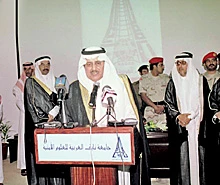
He was speaking to reporters Wednesday night after attending a ceremony for postgraduate students of Prince Naif University for Security Studies in Riyadh.
Prince Naif called on terrorists to respond to Wednesday’s amnesty for terrorists who surrender within a month announced by Custodian of the Two Holy Mosques King Fahd.
“The message was very clear, and wrongdoers must give themselves up by reporting to a government authority that they have recanted and then cooperate with (the authorities) so that Shariah law can be applied to them,” Prince Naif said.
“Those who want safety should take this opportunity and return to the right path,” he said.
The Interior Ministry announced yesterday that the first wanted terror suspect had surrendered under the amnesty.
“The citizen Saaban ibn Muhammad ibn Abdullah Al-Laylahi Al-Shehri, who was wanted in a security-related case and had been missing (for two years) surrendered to security authorities,” SPA quoted a ministry official as saying.
He did so “a few hours” after the amnesty was announced.
“In accordance with royal instructions, he was allowed to visit his family and stay with them until the date of his interrogation (for the charges) attributed to him is set,” the official added.
Sources earlier said the amnesty was aimed at mid-ranking and junior Al-Qaeda supporters, not leaders with blood on their hands.
Under the amnesty, which guaranteed personal safety for those who repent, the state would drop all charges while reserving the right of individuals harmed by terror acts to either seek redress through the courts or waive any claims.
King Fahd warned that the offer was a last chance for suspected extremists to turn themselves in and that those who did not would face a harsh crackdown.
Al-Shehri is not on a list of 16 most-wanted Al-Qaeda suspects who remain at large.
Prince Naif in Wednesday’s remarks denied Al-Qaeda has infiltrated the Saudi security forces. “The men of the Saudi security apparatus are too dignified and honorable to include such (elements). Be fully confident of that,” he said.
No weapons belonging to Saudi armed forces were used to carry out terrorist attacks. “This is certain”, he said.
The US Embassy yesterday issued a new warden message to nationals in Saudi Arabia urging them not to run security checkpoints despite reports that Al-Qaeda gunmen have donned uniforms to carry out attacks, a spokeswoman said.
The message “cautions Americans that it is dangerous to ignore Saudi police checkpoints” despite these reports, which related specifically to the June 12 abduction in Riyadh of US hostage Paul M. Johnson, embassy spokeswoman Carol Kalin said.
The advice was given “after it came to our attention that one American ignored a police checkpoint” following claims that Al-Qaeda had police uniforms and a car looking like a police vehicle in kidnapping Johnson, she said.
“We are aware of the denials, and we have said on record that there was no evidence of complicity” between security forces and Al-Qaeda, Kalin confirmed.
Prince Naif also denied foreign security agencies were involved in dealing with the recent terror attacks in the Kingdom, nor had there been any US pressure on Saudi security forces.
“No, there hasn’t been any pressure and we would not allow it,” the Saudi Press Agency quoted him as saying. “This must be made very clear. We deal with others on an equal footing.”
“We have intelligence contacts with the United States, Britain, Germany, France and Italy and with all Arab and Muslim countries. We appreciate the effort of all those who provide us with information.
“There is very good cooperation with American security agencies: they have benefited us and we have benefited them,” he added.
Saudi security forces meanwhile scoured several districts of the capital yesterday, signaling they were not letting down their guard despite the amnesty.
Security forces searched neighborhoods in north, south and central Riyadh, witnesses said. No arrests were reported yet.
Some 25 police and special forces vehicles raced through the upmarket Al-Olaya thoroughfare heading north after conducting searches in one block in the district, witnesses said.
(Mohammed Rasooldeen from Riyadh contributed to this report)