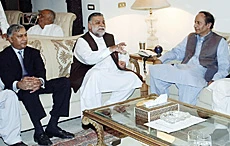
ISLAMABAD, 27 June 2004 — Pakistan’s Prime Minister Mir Zafarullah Khan Jamali has stepped down and ordered his Cabinet dissolved following months of speculation over his worsening relationship with President Pervez Musharraf.
The decision, announced yesterday by Jamali, raised questions about the pace of the country’s return to democracy five years after Musharraf’s bloodless coup in 1999.
But the change was unlikely to dramatically alter Pakistan’s commitment to either the US-led war on terror or fledgling peace talks with nuclear archrival India — matters which are firmly in Musharraf’s hands.
Chaudhry Shujaat Hussain, the head of the ruling PML-Q party, was nominated to succeed Jamali as prime minister. Hussain is all but certain to win the required vote of confidence in Parliament, where the ruling party has a majority. A vote was expected within days.
But Hussain’s days as prime minister might be numbered even before he takes the post.
Outgoing Information Minister Sheikh Rashid Ahmed said Hussain would be a caretaker prime minister and eventually give way to Finance Minister Shaukat Aziz — a senator who must gain a seat in the lower house of Parliament before he can be nominated.
Jamali said he hoped his resignation would help the nation’s political process, but didn’t elaborate.
Pakistan has been on a long and bumpy road from dictatorship to some form of recognized democracy. It won readmittance in May to the Commonwealth of Britain and its former colonies, after an embarrassing suspension following Musharraf’s coup.
Post-coup constitutional amendments empower the general to dismiss the prime minister and Parliament. He and Jamali had met earlier yesterday — but Jamali said he had stepped down, not been fired.
Opposition lawmaker Liaqat Baluch accused Musharraf of trying to ensure that no strong political rival can emerge.
“They stoked the fire around Jamali and then pushed him into it,” said Baluch, a member of the six-party religious coalition opposed to Musharraf. “The military rulers want to maintain their supremacy so that no political government is stable.”
Observers say Musharraf had grown impatient at Jamali’s inability to rein in opposition lawmakers and to effectively defend the government’s actions.
Jamali had insisted as recently as Friday that he wouldn’t resign. But a day later, he did.
“It takes courage to resign,” he said. “But I am not feeling that bad, because I have resigned from other positions in my life. This is nothing new for me.”
Jamali, one of Pakistan’s most seasoned politicians, became prime minister in November 2002 after the PML-Q, which supports Musharraf, won the most seats in elections the month before.