PANYOLA, Pakistan, 29 June 2004 — The distraught mother of a Pakistani man kidnapped in Iraq and threatened with execution begged his captors yesterday to release him, saying he had done nothing wrong.
Fighting back tears, Saeeda Jehan told Reuters she did not own a television, and only found out about Amjad Hafeez’s capture when relatives informed her and showed her the video footage broadcast by Pakistani channels.
“Hell descended on me when I heard the news,” she said at her sister’s house in the scenic, mountain village of Panyola, located on Pakistan’s side of disputed Kashmir about 70 km northeast of the capital Islamabad.
“I could not think straight.”
Wearing traditional baggy shalwar kameez trousers and shirt and a scarf over her head, the 45-year-old appealed to Hafeez’s captors to set him free.
“I appeal to the captors to release him in the name of humanity,” she cried, as male relatives sought to comfort her by saying her son would be freed.
“They are Muslims and we are also Muslims,” she said, speaking in Pahari, a dialect of Punjabi spoken by people in eastern Pakistan. “They have mothers too; they should feel the pain and agony of a mother and release him.”
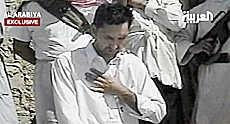
Al-Arabiya television aired footage of Hafeez and his captors on Sunday. Four masked men stood behind the crouching Pakistani, who displayed an identity card from American firm Kellogg, Brown and Root, which works with the US military.
The kidnappers said they would behead the captive if Iraqi prisoners being held in jails, including Baghdad’s Abu Ghraib, were not released.
The hostage also made a plea to Pakistani President Pervez Musharraf, a key ally in the US war on terror, to shut down the Pakistani Embassy in Iraq.
Hafeez’s uncle, Mohammad Razzaq Khan, said Hafeez was divorced and had three sisters and a brother. “He is the eldest son and the sole breadwinner for his family,” Mohammad told Reuters in Rawalpindi, near Islamabad.
Pakistan said it would not bow to the demands of the captors, who said they seized Hafeez in Balad, north of Baghdad.
“This Pakistani driver was employed by a company in Kuwait to ferry food supplies into Iraq,” a Pakistani Foreign Ministry spokesman said.
“(Our) liaison officer in Iraq is in touch with Iraqi authorities and the religious leaders to try to secure his release.
“The government of Pakistan has a stand that we condemn all forms of terrorism and we have our policy that we don’t accede to any conditions or demands made by hostage-takers.” A Foreign Ministry statement reiterated an earlier advisory telling Pakistani nationals to avoid traveling to Iraq.
Pakistanis reacted with outrage and grief yesterday to the news of the hostage taking, with some blaming the government for siding with the United States and others saying the kidnappers would not help their cause if they kill a fellow Muslim.
Most Pakistanis are deeply against the US-led war in Iraq, but the government has been one of Washington’s biggest supporters in the war on terror. Many here voiced anger at President Gen. Pervez Musharraf for that position, saying that Hafeez was now paying the price.
Nasir Hussain, a restaurant owner in the southern port city of Karachi, said he was surprised that the insurgents had stopped distinguishing between Americans and fellow Muslims.
“Being on the side of America has increased dangers for our country abroad and at home,” said Hussain, a reference to the string of attacks on Westerners since Musharraf threw his support behind Washington after Sept. 11.
Others condemned the kidnappers as terrorists and said they were shocked that they would threaten to kill a simple man for the policies of his government.
“I cannot believe it. I never thought Iraqis could be enemies of Pakistanis,” said Sumaira Anwar, a 30-year-old housewife in the eastern city of Lahore.
Added Mazhar Iqbal, a 45-year-old businessman in Lahore: “I don’t believe in killing people for religion. The captors of the Pakistani are simply terrorists.”
A university student in the northwestern city of Peshawar demanded Hafeez’s captors release him. “This will not help their cause,” said 23-year-old Azmat Khan.
“Musharraf should realize that poor people are paying the price for what he is doing,” said Osmanullah, a guard for an international organization in Islamabad.
“Pakistan should not bow before the terrorists,” added Mehjabeen Ghazanfar, a school teacher in Karachi. Liaqat Baluch, a lawmaker from the six-party religious opposition, condemned the kidnapping, but he also called on Pakistanis not to work with the Americans in Iraq.
“Our sympathies are with him and we pray for his well being,” Baluch said. But Pakistanis in Iraq “should not work at American bases there. They should not work for mere American money.”
Pakistan has said it was considering a request made by the United States in April to contribute troops to protect the United Nations in Iraq. Pakistan had previously said it would only contribute troops to a peacekeeping force in Iraq with the consent of the Iraqi people. Such a deployment would be hugely unpopular with many Pakistanis, who are wary of Musharraf’s pivotal role in the war on terror.