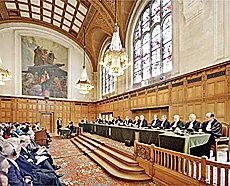
THE HAGUE, 10 July 2004 — The International Court of Justice ruled yesterday the wall Israel is building to seal off the West Bank violates international law, and urged the United Nations to take action to halt its construction.
The court dismissed Israel’s arguments that the wall was essential for its security, and said the infringement on Palestinians’ ability to move freely was unjustified by arguments of military necessity.
The ruling was a rebuff not only to Israel but also to the United States and several European nations which had argued that the issue should not be before the court.
“Israel is under an obligation to terminate its breaches of international law; it is under an obligation to cease forthwith the works of construction of the wall being built in the Occupied Palestinian Territory, including in and around East Jerusalem, to dismantle forthwith the structure therein situated,” said the ruling, read by court president Shi Jiuyong of China.
The court also ordered Israel to pay reparations to Palestinians harmed by the barrier and return land seized to construct it.
“The court is of the view that the United Nations, and especially the General Assembly and the Security Council, should consider what further action is required to bring to an end the illegal situation resulting from the construction of the wall,” the judgment said.
The judges were unexpectedly united in backing the decisions, by a vote of 14-1 for most paragraphs of the decision, with only the American judge dissenting.
The court also said all countries “are under an obligation not to recognize the illegal situation resulting from the construction of the wall and not to render aid or assistance in maintaining the situation created by such construction.”
In Washington, White House spokesman Scott McClellan denounced the decision, saying the United States believed the dispute should be resolved politically. “We’ve always said that is not the appropriate forum to resolve what is a political issue,” he said.
At the Palestinians’ request, the UN General Assembly asked the world court last December for its opinion on the legality of the barrier — a 685-km long complex of high concrete walls, razor-wire fences, trenches and watch towers. About one-fourth has been completed, much of it close to the pre-1967 border, but some dipping into the West Bank. The court said the barrier was routed in a way that would encompass 80 percent of the Israeli settlers in the West Bank, while cutting off more than 230,000 Palestinians from their surrounding areas.
Despite Israel’s protests that the barrier was temporary and not designed as a political boundary, the court said it could amount to “de facto annexation” by creating new facts on the ground.
It said the building of the barrier “severely impedes the exercise of the Palestinian people of its right to self-determination, and therefore is a breach of Israel’s obligation to the respect of that right.”
The court’s advisory opinions are nonbinding, but bear moral and historic weight.
In one brief reference, the court said the construction of the barrier should be seen in the context of “the succession of armed conflicts, acts of indiscriminate violence and repressive measures” since 1947, when Israel declared itself a state.
At the outset of the 2 1/2-hour session, the court ruled it had jurisdiction and dismissed Israel’s objections that the UN General Assembly acted irregularly in asking the court for an advisory opinion.
It also rebuffed the argument that the court’s interference could disrupt Middle East peace efforts, and that the issue was political, not legal. “A legal question also has political aspects,” said the ruling.
The court said it was aware of the political negotiations — in particular the US-sponsored road map — but said it was not clear its legal opinion would influence those efforts.
The court dealt in passing with issues long at dispute between Israel and the Arab states. It determined that the lands captured by Israel in the 1967 Middle East war are occupied territory, including East Jerusalem. Israel has refused to recognize Jerusalem as occupied since it was formally annexed by the Israeli Parliament shortly after the war.
While the General Assembly and Security Council had never recognized Israel’s claims, it was the first time Israel’s status in the West Bank was the subject of an international legal judgment.
Predictably, the Palestinians welcomed the ruling while the Israelis denounced it.
Palestinian President Yasser Arafat: “This is an excellent decision. We thank the court in The Hague. This is a victory for the Palestinian people and for all the free peoples of the world.”
Israeli Finance Minister Benjamin Netanyahu: “What’s going to happen now? This is going to go to the UN General Assembly. They can decide anything there. They can say that the Earth is flat. It won’t make it legal, it won’t make it true and it won’t make it just.”
Raanan Gissin, senior adviser to Israeli Prime Minister Ariel Sharon: “I believe that after all the rancor dies, this resolution will find its place in the garbage can of history.”
Nabil Abu Rudeinah, senior adviser to Arafat: “The next step is to approach the UN General Assembly and Security Council to adopt resolutions that will isolate and punish Israel. As of today Israel should be viewed as an outlaw state.”
European Commission spokesman Jean-Christophe Filori: “...the European Union continues to call on Israel to remove the barrier from inside the occupied Palestinian territories, including in and around East Jerusalem.”
Arab League Secretary-General Amr Moussa: “The message that was very forcibly sent by the court is that upholding and respecting international law should be the basis for strong international relations.”
GCC Secretary-General Abdulrahman Al-Attiyah: “The United Nations must take the required measures to ensure implementation of the court’s ruling, which demands Israel’s removal of the wall.”
Jordanian Foreign Minister Marwan Muasher: “The ICJ’s ruling represents a large legal, ethical and political weight which Israel cannot ignore.”