
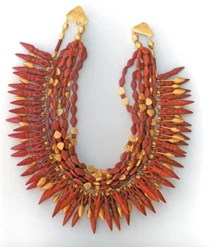
A Nakhla jewel is first and foremost exclusive. It is hardly ever advertised or even displayed. Yet Nakhla's customers include the Spanish, Japanese, British and Jordanian royal families as well as such media stars as Isabella Rossellini and Barbara Walters.
Unlike other jewelry shops, Nakhla lacks a shop window. Only a selected few who know walk through the very ordinary and nondescript facade behind which wonderful things are found. To those who know, however, a Nakhla jewel is instantly recognizable because of its inimitable and unique style. Ikram Nakhla sold his first pieces in 1966 when he was still a student in Italy; the idea took root with weekly visits to Mrs. Naguib Ghali: "Every Thursday she held a coffee morning in her home. She displayed her latest jewelry which she sold for charity. She inspired many men and women of my generation. She made us understand the depth and richness of our pharaonic and Islamic heritages. She was truly my mentor."
Ikram made his first gold pieces in 1972 sold them from home. With the help of his wife, Layla, one of his very first clients, he opened a shop in 1980. He describes his style as "a new concept of an old jewel. Its structure is taken from the past and yet when you look at it, you notice its modern line." It is this mingling of old and new that gives Nakhla its unique style. He rightly insists that his creations are not reproductions but inspired elusively by any object he finds attractive. He recently designed a ring whose original shape calls to mind Tutankhamun's headrest displayed in the Egyptian Antiquities Museum in Cairo. Yet one might also see a pair of gold wings or twin leaves or even a pair of pearls. In the world of Nakhla, imagination transcends history and reality gives way to exuberant creativity.
The necklaces not only reveal superb craftsmanship but also a brilliant, even magical, sense of color. Ikram's passion for color has undoubtedly led him to favor semi- precious stones. He began using them in the 70's, a time when most Middle Eastern women preferred precious stones. He recalls with a smile that when he first made jewelry from rock crystal, customers thought it was plain glass! He does use precious stones but insists that certain semi-precious stones — such as tanzanite — can be even more expensive than sapphires! He confesses that one of his hobbies "is to find new stones, new colors and create new color combinations!" Nakhla has one principle: each one of the jewels has to be both beautiful as well as unique. "My jewelry is exclusive. I generally make only one piece. In certain cases, I might make two necklaces with a similar design but always an entirely different color combination. And we also keep c1ose track of our customers."
Wearing a fine piece of jewelry is still an obvious way to express wealth and fulfill the desire for self-adornment. From earliest times, man has ornamented his body. Archaeology has shown that the appreciation of gemstones goes far back into prehistory. "Our strength lies in our use of colored stones. Painstaking efforts are needed to produce a necklace so I am always on the lookout for new stones. Presently my favorite stone is an hymomorphite, a blue stone." Despite his whims, be admits that over the years he has always favored earth tones and rock crystal but he emphasizes that he always considers the latest fashion trends. Every year Nakhla creates a collection on a single theme. Some of his recent pieces have been influenced by Egypt's Graeco-Roman period. A stunning necklace of pearl rubelites and iolites intertwined with tiny gold bunches of grapes recalls a Graeco-Roman stele found in Fayoum. An earlier collection was based on the 'mashrabiyyah': "The Islamic period is rich. I am interested in old houses especially the workmanship of the mashrabiyyah, the wooden screens. When I decide on an idea, I create a necklace around it. In this case, I decided to make the small fragments of the wood in gold and incorporate them into necklaces. I have also produced collections inspired by soft furnishings, Persian carpets, flowers, leaves and even door handles!" Ikram readily admits that the pharaonic period provides an endless source of ideas. Pharaonic jewelry is timeless; the pieces are exquisitely refined and show perfect proportions as well as superb techniques. Lately, he confesses that he has been attracted by Africa. "African art is rough, graphic and terribly modern!" It is interesting to note that the Ashanti who live in part of what is Ghana are renowned for beautiful gold jewelry remarkable for their bold design. Who would guess that Ikram Nakhla is by profession a chemical engineer? He confesses that he hardly ever worked as an engineer and concentrated on agriculture and jewelry. "I am lucky to enjoy what I am doing and the people who come into the shop also enjoy themselves. I never feel I am working!"