BAGHDAD, 7 August 2004 — US Marines claimed yesterday that they had killed 300 fighters loyal to Iraqi Shiite cleric Moqtada Al-Sadr in fierce clashes as US planes pounded the central Iraqi city of Najaf.
The clashes pose a stern test for an interim government struggling to stamp its authority over the country.
A spokesman for Sadr denied that many fighters had been killed in Najaf in the past two days.
He said 36 militiamen died in several Iraqi cities from clashes that have fueled fears of a new rebellion of radical Shiites. The fresh fighting, which still raged yesterday, marks a major challenge for US-backed Prime Minister Iyad Allawi and appears to have destroyed a two-month-old cease-fire between US forces and Sadr’s Mehdi Army. “The number of enemy casualties is 300 KIA (killed in action),” Lt. Col. Gary Johnston, operations officer for the 11th Marine Expeditionary Unit, said at a military base near Najaf, 160 km south of Baghdad. “The Marines are here and I think you know how they operate. If you kill a Marine, the Marines are going to fight back.” Johnston said two Marines had been killed and 12 wounded. He told reporters that the Mehdi fighters were badly coordinated and shot at random against the heavily armed Marines who were backed up by F-16 fighter jets, AC-130 gunships and helicopters. Much of the fighting took place around the mausoleums and small caves of Najaf’s ancient Shiite cemetery, the largest in the Arab world and a popular sanctuary for Mehdi fighters.
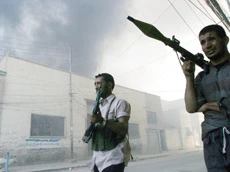
In Najaf’s streets, market stalls burned as ordinary Iraqis cowered in their homes. Thick black smoke rose over the city. Despite the Marine onslaught, hundreds of Mehdi militia carrying AK-47s and rocket-propelled grenades roamed the city near Najaf’s mosques.
Gunfire damaged the dome of the Imam Ali Mosque, some said.
US military officials said there were indications that foreign fighters had joined the militia. The US-appointed governor of Najaf put the militia death toll at 400, with 1,000 captured. He said he had information 80 Iranians were fighting alongside Sadr’s militia, whom he ordered to leave the city in 24 hours. Sheikh Raed Al-Qathimi, a spokesman for Sadr, rebuffed the American version of the death toll. “I categorically deny these American lies,” he said. Tension had been rising in Najaf since Iraqi security forces surrounded Sadr’s house earlier this week. But US officials said fighting escalated when Marines came to the aid of badly outgunned Iraqi police who were attacked by insurgents wielding heavy weapons early on Thursday.
Col. Anthony Haslam, the Marine base commander and chief of operations in Najaf, estimated the number of Mehdi fighters at more than 2,000. The US military added it was not pursuing Sadr. British and Italian troops also fought the Mehdi militia across Shiite-dominated southern Iraq — in Basra, Amara and Nassiriyah — while fighting raged in Sadr City and Shoula, two Shiite districts of Baghdad.
The Health Ministry said fighting in Sadr City alone had killed 20 Iraqis and wounded 114 since early on Thursday, while in Nassiriyah six were dead and 13 wounded. The flare-up of tension with radical members of Iraq’s majority community comes after Shiite militants rose up across south and central Iraq in April and May.
Iraq’s interim government expressed confidence it could deal with the crisis. It is already grappling with a spate of car bombings, assassinations and kidnappings of foreign hostages. “We have every confidence in our new government, our security forces and our allies to contain this conflict,” Foreign Minister Hoshiyar Zebari said.
In the previous uprising, hundreds of Iraqis and dozens of US troops were killed. Yet Sadr, a young cleric with an ardent following among poor, disaffected youths, appeared keen to stop the latest fighting. Via another spokesman in Baghdad, he called for a resumption of a truce struck in June. “We have no objections to entering negotiations to solve this crisis,” Mahmoud Al-Sudani told reporters. “As I have said in the name of Syed Sadr, we want a resumption of the truce.”
Col. Haslam said he had heard nothing of the offer. While Sadr may be popular with frustrated young Shiites, many of Iraq’s mainstream community follow Ayatollah Ali Al-Sistani, the most influential Shiite cleric in Iraq who has carefully and quietly tried to keep a lid on Sadr’s agitating.
In a worrying move for his followers, Sistani, a 73-year-old Iranian-born cleric, flew to London yesterday for treatment of a heart problem, sources said.
US Marines recently replaced the US Army in Najaf and analysts have suggested the upsurge in violence is linked to the Marines taking a more aggressive approach with Sadr’s militia.
At the same time, attempts by the interim government to draw Sadr into the mainstream appear to have faltered, which may have prompted the cleric to redouble his militant approach.
—Additional input from agencies