
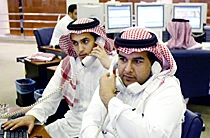
JEDDAH, 16 August 2004 — Unfazed by the escalating unrest in Iraq, first half earnings dominated the financial scene in the GCC region. Together with valuation concerns and questions over the sustainability/over-extension of the region-wide two-year market rally, the strong first half earnings have rekindled optimism and provided for a further catalyst to drive stock markets higher, according to a report prepared by the Kuwait-based Global Investment House (GIH).
With all eyes focused on profit announcements, a number of encouraging profit reports across the region drove the markets higher during July.
“Barring Oman, the remaining GCC markets all produced gains. Boosted by strong earnings and surge in confidence which highlighted 2003 trading, the Kuwaiti market wiped out all of its accumulated losses during July (+5.1 percent), climbing well into positive territory by month end. As a result, all of the GCC markets are now in positive territory,” the report said.
“Also during July, the buoyant mood of the Saudi market, 8.1 percent gain on the month and 39.2 percent on the year, propelled it to the forefront of regional markets, overtaking the Qatari market, despite the latter making up lost ground and producing nearly 3.9 percent gain during the month,” the GIH said.
“The UAE market also continued its winning ways during July, surpassing the key 6,000-point mark during the month, only to recede back below the benchmark value before month end, nonetheless producing 6.8 percent gains for the month and 30.3 percent YTD gains,” the report said.
With the UAE and Saudi Arabia both registering solid gains during July, three regional markets have now surpassed the 30 percent mark.
A marginal correction at the Omani market, which snapped sixth consecutive months of gains has been long overdue, the report said. “The Omani market, which has been overshadowed time and again by its larger peers, has been making commendable headway away from the spotlight, and the marginal fall registered during July is no reason for concern, as the market will bounce back on the announcement of privatization plans and upcoming initial public offerings (IPOs).”
According to GIH July’s momentum should continue to take regional markets forward during August. “Stronger than expected global oil prices and the surge in corporate profitably have provided a supportive background for equities, and the continued flow of earnings during August to stimulate further gains.”
However, the markets will be driven on improved confidence rather than increased demand for equities during August, as the summer season has now reached its peak and investors have historically favored vacationing to trading. Nonetheless, increased trading will most likely occur on selected counters, in which corporate profitability outperforms investor expectations.
Although the favorable sentiment in the region produced $24 billion in gains during the month, as market capitalization reached $373.8 billion, up 6.4 percent over its June value, investors preferred vacationing to trading, as both aggregate volume and value of shares traded during the month retreated. “On the volume front, the UAE was the only market to witness an expansion in shares traded, translating into a region-wide fall of 1.7 percent compared to June results. As regards value, Saudi Arabia was the sole market to produce a higher value during the month, as the overall value changing hands in the GCC fell to $40.9 billion, down nearly 1 percent from its June level,” the report said.
Regionally, 189 companies have reported first half profit gains (by the end of July) of about 38.6 percent over last year. “The positive news on the corporate-earnings side reveals that corporate profit growth is one of the main factors underpinning growth in the markets, in fact, outpacing regional stock market gains,” the GIH report added.
With the exception of the investment sector, the remaining 9 sectors have achieved an aggregate growth in excess of 41 percent.
Hotels & Tourism companies achieved the highest growth, seeing their profitability increase by 238.2 percent, backed by increased regional tourism and rising interest, of both government and private sector, in developing the nascent tourism sector. Agriculture/food companies have also produced profit growth of 231.1 percent, while the industrial sector (represented by 51 companies) registered commendable growth of 63.4 percent, backed by outstanding growth in the region’s industrial giant Saudi Basic Industries Corp. (SABIC) and a turnaround in profitability by a number of smaller industrial players.
The report said that the GCC telecommunication sector has for long been dominated by monopolies with ownership profiles that are closely linked to regional governments, if not entirely owned by them. In all GCC countries, mobile telephone services, both GSM as well as fixed line, have been initiated by the government, which followed with the trend of partial dilution of the government holdings in telecom companies with listings on the stock exchanges.
Now there is a trend of opening up of the telecommunication sector with the issuance of licenses for the second and third operator in the wireless segment, a move toward liberalizing the telecom sector, which appears to be cautious and gradual. The liberalization of the sector is part of the GCC nation’s commitment toward meeting Word Trade Organization (WTO) requirements.
The report noted that telecom regulators in Oman and Saudi Arabia have already awarded a second mobile license during this year. Qtel in Oman and Etisalat in Saudi Arabia, along with their consortium partners, have won the license to operate as the second GSM operators in these countries. Furthermore, the UAE has declared its liberalization plan, which suggests that at least one additional mobile operator would probably be licensed in the UAE during 2005. In Qatar, Qtel’s monopoly in the domestic market would probably end by 2006 with the licensing of a second mobile operator. Therefore, the region is likely to witness sweeping changes.
Over the past three years, countries such as Bahrain, Oman, Saudi Arabia and UAE have established independent telecom regulatory authorities, while the rest of the countries in the region are in the process of following suit.