
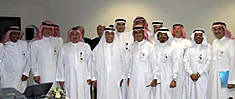
JEDDAH, 21 August 2004 — The impact of the Kingdom’s expected entry into the World Trade Organization (WTO) on the financial service sector including the area of banking and insurance industry was analyzed at a recent brainstorming session hosted by the National Commercial Bank here.
Dr. Fawaz Al-Alamy, deputy minister of commerce and industry for technical affairs, who was the guest speaker last week, dwelt at length on the progress of negotiations ahead of Saudi Arabia’s WTO entry.
He said the Kingdom had vigorously pursued its membership in the organization and signed binary agreements with 35 countries, which are already WTO members and had requested to negotiate with the Kingdom. He said 148 countries are members in the organization, which control 89 percent of the world trade, 90 percent of financial transaction and 91 percent of the telecom sector.
Dr. Alamy also indicated that the Kingdom would become mandated by the organization’s twenty-eight agreements before completing the membership procedure.
Responding to a question, he said 500 experts and specialists from various government ministries and institutes were involved in the negotiating process, 23 of whom in the direct management of talks.
He also explained that the mechanics of negotiations depended on the management of dialogue with the members of the organization within the limits drawn by the board of ministers, based on the recommendations of the ministerial panel supervising the membership process.
The deputy minister also indicated that the agreement with any of the affiliate countries obligates the rest of the countries to comply with all the signed requirements of the agreement with that nation.
He added that the United States was the only one of the affiliated countries with which the negotiations had not yet concluded; nevertheless the negotiations had reached advanced stages.
NCB General Manager Abdulhadi A. Shayif, who welcomed Dr. Alamy with senior executives of the bank, said that the deputy minister’s visit was in line with NCB’s strategy of updating information through exchange of expertise by means of continuous communication with the government sector associated with the business community and the country’s economic and financial activity.
He emphasized that the NCB invested great care in such exchange which will have considerable effect, be it on the national economy in general or on financial and banking institutions in particular. “Without a doubt, the national banks are achieving a progression of accomplishments on performance or profit levels.
Dr. Alamy’s speech on the subject will go a long way in helping the NCB to raise its sights toward new challenges likely to be thrown up by the Kingdom’s WTO membership. It is necessary to prepare for this, and derive benefit from new legislations and laws which will determine the performance of banks in all participating nations,” he said.
Shayif said that the Kingdom had come a long way in updating a number of systems in the last quarter in synchronization with the structural changes which the national economy has witnessed. The NCB general manager regards economists and experts in such areas as bearing a great responsibility in explaining the economic changes at a time when economics has begun to play a leading role in the lives of individuals, companies and nations. It is no longer a theoretical science taught at universities, but one of the influential factors in daily decisions for various sections of society.
Shayif also thanked Dr. Alamy for accepting the invitation to visit the bank and brief his deputies about the latest economic developments.