
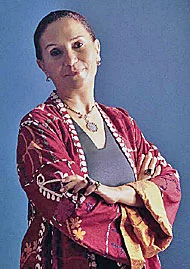
Azza Fahmy success story is characterized by passion. A passion for jewelry which began thirty years ago: “My long involvement with jewelry making all began with a book,” says Fahmy. The art book which dealt with European jewelry of the Middle Ages inspired her to become what she is today: A leading jewelry designer in the Arab world and the first Arab woman to achieve an international reputation in the field.
When Fahmy graduated with a Bachelor of Fine Arts (BFA) in Interior Design, she originally planned to enroll in the Faculty of Fine Arts for a second degree in the Applied Arts Department; however, she decided to do some on-the-job training and headed for Cairo’s renowned Khan El Khalili in search of the most skilled silversmiths.
“I tied my hair back, put on overalls and spent my days in a workshop full of men, learning the tricks of making jewelry.”
She recalls how it was seen as socially unacceptable, not to mention a bit mad, for a fine arts graduate with a responsible government job to work as an apprentice in a workshop. Her apprenticeship in Khan El Khalili lasted for two years and during that time, she made her first rings. She describes them now as “primitive” but they nonetheless were sold at her first exhibition.
Her breakthrough came in the mid-seventies when the British Council gave her a fellowship to study jewelry making at the London Polytechnic. When Fahmy returned to Cairo, she felt she had the skills and the confidence to pursue her goal and by the early eighties, she had set up her own workshop and employed two workers. Today, the workshop which she established has been transferred to a new location in the 6th of October City. She also has a new factory and a hundred employees; demand is great and work is steady. In addition to galleries in both Cairo and Alexandria, she opened a shop in Bahrain in 2002 and in Dubai in December of 2003. “ When I was in the Emirates, peoples often came up to tell me how proud they were that an Arab woman is keeping the traditions of Arab jewelry alive.”
It is to Azza Fahmy’s credit that through innovation and modern design that she has created a market for traditional jewelry. “I have come up with the idea of ‘new modern traditional jewelry’ along with mixing gold and silver. Only thirty years ago the upper middle classes and the middle classes shunned traditional silver jewelry; it was worn only by the lower classes. Now things have been reversed and all Arab women enjoy wearing traditional silver jewelry designed in a modern way.” One of her first successful collections featured the traditional mud architecture of Egypt. Appropriately called “Houses of the Nile,” Fahmy designed rings and pendants in the shape of small houses encrusted with palm trees or rocks. At the time a critic wrote: “The beauty of this collection is that most people never thought of wearing mud houses but Azza Fahmy did.”
From that time, Fahmy has been constantly searching for new sources of inspiration. Her love for poetry led her to translate this passion into jewelry. She created a collection based on Salah Jahin’s poems, engraving the verses on necklaces, bracelets, earrings, rings and key chains. Following the commercial success of the collection, jewelry with inscribed and engraved verses became Fahmy’s signature. At the same time, she decided to use silver and gold in a single piece of jewelry. This winning combination became another of her trademarks: A verse or a proverb written in beautiful calligraphy is first inscribed on silver and then inlaid with gold. Later collections featured Khalil Gibran, Ibn Hazm’s celebrated ‘Ring of the Dove,’ Rumi, Ibn Al-Farid, Ibn Al-Arabi and Nizar Kabbani.
Her newest collection, Sahara 2005, features gold and silver work adorned with semiprecious stones such as garnet, amethyst, peridot and cornelian. It was recently inaugurated at the Mena House Pyramid Tent overlooking the Pyramid of Cheops in a typically Egyptian desertscape. The jewelry was presented by models wearing dresses specially created for the event by the famous Tunisian fashion designer, Soucha..
Fahmy’s fascination with the desert is not new. She has traveled extensively in the Egyptian desert as well as in southern Oman: “I like the feeling of serenity when I am in the desert and I love desert crafts — all of them: The leather work, the pottery, the tent, the wooden objects. I am overwhelmed by the simplicity of the desert people. Creating the Sahara collection was a dream come true.”
Tassels are the main theme of the collection: “Girls in the Arab world, who use them in braiding their hair were the inspiration behind this idea,” she explained.
Although she feels the desert can be an endless source of inspiration, Fahmy is already working on new ideas for future collections. “My village in the delta will be the source of inspiration for a new line. I also dream of combining old European jewelry with our traditional jewelry. I am very interested in 18th and 19th century European jewelry.”
Fahmy’s newest venture will be the launching of a book on Egyptian jewelry. When asked why she felt the need to write a book, she replied that she had accumulated a great deal of information.
“ I have been collecting jewelry from all over Egypt for more than forty years. I have also had the chance to learn from some of the best masters. At the same time, I am privileged to be a technician, a researcher and a collector. My life is in this profession. The more I learn, the more I experience and the more I feel I have the ability to do.”