BAGHDAD, 15 September 2004 — An Al-Qaeda-linked insurgent group yesterday targeted the Iraqi police, killing 59 people in attacks in the capital Baghdad and the eastern city of Baquba. A car bomb ripped through a busy market near the Baghdad police headquarters where Iraqis were waiting to apply for jobs on the force, killing 47 people. And gunmen opened fire on a van carrying police home from work in Baquba. That attack left 12 policemen dead. At least 114 people were wounding in the two attacks.
The Al-Qaeda-linked group Tawhid wal Jihad, headed by Jordanian militant Abu Musab Al-Zarqawi, claimed responsibility for both attacks. “With the grace of God, a lion from our martyrdom brigades was successful in striking a center for police volunteers,” the military wing of the Tawhid wal Jihad said in statement on the Internet. In a separate statement, the group also claimed the killing of the policemen in Baquba.
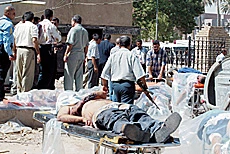
The blast devastated buildings and gutted cars near the western Baghdad police headquarters on Haifa street, an insurgent enclave that has been the scene of fierce clashes with US troops. Though the attack apparently targeted police, many of the dead were people who had been shopping or having a morning meal.
Shrapnel tore the crowded district, littering body parts everywhere and leaving pools of congealed blood on the pavement.
“More than 200 people were queuing outside the main gate. I came with six friends and now I’m alone. They’ve gone, all of them,” said aspiring police recruit Nabeel Mohammed, slightly wounded in the blast.
Anguished relatives, seeking news of loved ones, frantically turned over ID cards or inspected dozens of pairs of shoes lined up on the roadside by police near the crater gouged in the ground by the blast.
Interior Minister Falah Al-Naqib blamed the bombing on “Arab groups” as angry men cursed US President George W. Bush.
Mahdi Mohammed, 30, was standing outside his barber shop when the explosion went off. “It was a horrific scene. Seconds earlier people were drinking tea or eating sandwiches and then I could see their remains hanging from trees,” he said. “I could see burning people running in all directions.”
“This is a crime committed against innocent people who needed to find work to feed their hungry children,” said Alaa Khamas, a falafel vendor. He said he saw a man who had just bought a falafel from him killed by a flying car wheel.
The attack in Baquba occurred when the policemen were returning to their station after they were told that a trip to a training camp has been postponed, said an officer, speaking on condition of anonymity.
It was the second recent attack on Baquba security forces: On July 28, a car bomb exploded outside a police recruiting center in the Sunni-dominated city, killing at least 68 people.
Attacks on Iraqi security forces and police officers — seen as collaborators by militants — have left hundreds of people dead since insurgents began a 17-month campaign to expel US-led forces and destabilize Prime Minister Iyad Allawi’s government.
In another predominantly Sunni town, Ramadi, US forces and insurgents clashed, resulting in the deaths of at least 10 Iraqis. Witnesses said insurgents had opened fire on US tanks which were trying to enter the town from the west. US forces returned fire, killing the Iraqis and destroying some shops, they said.
The US military said it did not immediately have any information on the fighting.
The US Army lifted its siege on the northern city of Tall Afar, which has been severely damaged by intense fighting, but few residents returned. Tall Afar, where more than 50 people were killed last week in pitched urban conflict between insurgents and US troops, was a ghost town yesterday.
Local residents ventured inside the town only to retrieve their belongings and expressed fears about a fresh outbreak of unrest. US troops were posted only on the outskirts of the city in armored vehicles. Only policemen were seen inside Tall Afar.
At the entrance to the city, farmer Qaiss Hatem Abdullah, 56, said “my family and I want to go back to Tall Afar, but we are afraid military operations will break out again like in Najaf and Fallujah.” Another man, Mohammed Abdul Amir Haidar, staying with his family in a refugee camp, said: “I prefer to stay in the camp... because the situation in Tall Afar is so unpredictable.”
Kidnappers, meanwhile, released a Turkish translator after Turkey protested over the US offensive in Tall Afar, but two more Turkish truck drivers were kidnapped near Tikrit.
Turkey’s NTV television reported that Iraqi militants said in a videotape aired on Turkish television they had released Aytullah Gezmen, abducted in late July.
Two more Turkish truck drivers were kidnapped near Tikrit, the state-run Anatolia news agency reported. The two drivers were on the way to Kirkuk when they were kidnapped, the agency said.
A group calling itself “Squads of Unification Lions” abducted a Jordanian and threatened to kill him unless his employer pulls out of Iraq within 48 hours.
— Additional input from agencies