
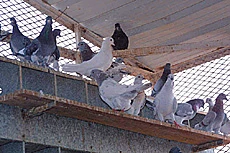
Raising pigeons in Saudi Arabia goes back many years. Many people raise them as a hobby while others do so as a profit-making business. The fact is that some highly sought-after pigeons fetch prices well into the thousands of riyals. There are other rare varieties, which also bring high prices. Particularly in Makkah, Madinah and Jeddah, raising pigeons is popular. People often build elaborate cages for the birds on top of their houses or on farmland outside the cities.
In Makkah we met Amin Al-Sayeed who said, “Raising pigeons is not easy. I have been doing it for 20 years and I am so involved that I check on them every day — sometimes more than I check on my children. If you want to raise pigeons successfully, you must know how and where to build their cages. They need an open area with plenty of air and sunshine where they can fly around. Boxes for them must be built in the cages and on the walls since as many as 30 pairs of pigeons are in a single cage. You must also know what pigeons like to eat. You cannot give them leftovers with a lot of spices. They want wheat, corn, millet and lentils. And don’t forget that water is very important; you must change their water at least once a day so that it stays clean. Pigeons are not strong and any mistake that you make could kill them. You have to be as careful with them as with your children. Perhaps even more.”
Qurban Muhammad who raises pigeons and works in a pigeon shop in Madinah told Arab News: “A pigeon keeper must take care of his birds by cleaning the boxes every day and giving them fresh food and water.
The keeper must have sharp eyes and be on the lookout for any change or sign of ill health in any bird. Sick birds must be isolated and treated immediately.
If the weather is good, the keeper should let his pigeons out for at least three hours a day. What is so interesting about pigeons is that they will always return to their cage. You can let them out and be sure that they will come back.”
Abu Hilal, a pigeon keeper in Jeddah, said, “Raising pigeons is both difficult and profitable. I don’t worry about financial problems because if I am short of money. I take a few birds to auction. I know I will get I go to the Pigeon auction and sell one or two pairs. I know that there are crazy people out there just like me who are willing to pay good money for birds. Now when you buy pigeons, you must be sure to keep them in a safe place; their worst enemy is cats. I will never forget the time when I bought two pairs of Bukhari pigeons for more than SR2000 and I was delighted to have got them. I pulled out a few feathers so they would not fly away until they had got used to their new cage. They were on top of my house in the cage where I keep all my birds though I did have them in a special section. Sadly, I forgot to lock that section and left to do something else. When I came back, I found a big cat eating my four new pigeons. And because I had pulled out some of their feathers, they couldn’t fly away and escape. Anyway, I can tell you that a while later, I found the cat and can assure you he will not kill any more pigeons.”
Saeed Ali, a pigeon keeper, told us: “There are many different sizes and shapes of pigeons and their prices vary depending on the breed. The prices range from SR200 to more than SR20,000. The cheapest one that I have is a Hasawi which cost SR200. I have a Mudhafar which cost SR1500 and also a many-colored Bukhari which cost about SR600. There is the Naffakh which has a large distinctive throat and costs about SR500. The most expensive of my pigeons are the Jacobeens which cost around SR15 thousand for a pair. There are many other kinds such as Rehani, Romani, Amri, Sherazi, Sudani and Baljiki. The most sought-after of all is the flipper which people love because of the show it puts on when it flies. It is called “flipper” because it flips over in the air when it flies. The most beautiful of my pigeons is called Al-Najma which cost about SR300”.
According to Qurban Muhammad, there is a Friday pigeon market in Madinah every week. The market gets going after fajr (dawn) prayer and ends about ten o’clock. Pigeon lovers and enthusiasts never miss it as they are always on the lookout for rare and beautiful birds. In the market, pigeons are sold and exchanged and if there is more than one buyer for a bird, an auction is held. Most pigeon keepers tend to keep their birds outside the city where they are safer.