
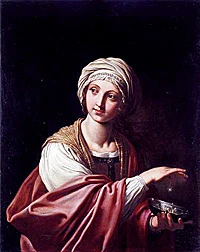
Of all the romantic figures in antiquity, undoubtedly Cleopatra is one who appeals to the modern imagination. The last queen of Egypt, she lived the most extraordinary of lives. Cleopatra VII, born about 69 BCE, was the last queen of the Ptolemies, a dynasty founded circa 305 BCE by Ptolemy I Soter, son of Lagus who was a general in Alexander the Great's army. He seized control of Egypt after Alexander's death. The great Cleopatra, however, was only the first in her line who actually spoke the language of the Egyptians which was among the half dozen languages that she is known to have mastered. When she came to the throne, the Ptolemaic royal house had been considerably undermined, and the independence of the country was fragile in the face of Rome's ambitions, which had already swallowed up most of the Mediterranean basin.
A civil war in Rome had left chaos in its wake, both in the Roman world and in Egypt, but the politically astute Cleopatra, by allying herself first with Julius Caesar and then with Mark Antony, two of the most powerful Roman military leaders, managed to hold on to her throne and preserve her country's autonomy for another twenty odd years. It all ended in 31 BCE off the coast of Greece in the naval battle of Actium. Antony and Cleopatra were defeated by Octavian, the grand-nephew of Julius Caesar The defeat signaled the end of the political ambitions of Cleopatra and Antony.
Cleopatra chose suicide as her option, following Antony into death in order to escape the dishonor of being taken to Rome and paraded in triumph by her vanquisher Octavian, the future Augustus. No one knows whether Cleopatra's courageous gesture of defiance — perhaps carried out with the aid of an asp concealed in a basket of figs as her first biographer Plutarch suggests - conferred the immortality promised to her by Egyptian beliefs. Nevertheless, she achieved immortality by a different route: she became a legend. 'Cleopatra as Mirrored in Western Art' was an exhibition which ran this past summer at Geneva's Musée Rath. The exhibition brought together over eighty paintings, sculptures and engravings -- by major artists from the 15th to the 20th centuries -- that explored the myth of Cleopatra in art. Inspired by classical authors, writers, poets and playwrights, their art took inspiration from her life to forge an ambiguous myth of Cleopatra which was far from univocal or monolithic; she was a woman to be admired for her courage, her political intelligence, but also a dangerous seductress, a femme fatale who brought death to her lovers. She is also seen as an emblem of stoicism and even a symbol of death.
The exhibition emphasized iconographic differences and similarities of Cleopatra in all her guises. It encouraged the visitor to think about how artists working at different historical moments and in various cultural contexts formed, reformed and even deformed images of her story to suit the myth-making imperatives of their time. Each brought something different - often reflective of a particular historical moment - to their portraits of Cleopatra. Since the earliest depictions of Cleopatra, the death scene has been favored by artists. Over time, other episodes came to enrich the iconographic vocabulary: the meeting of Cleopatra and Mark Antony at Tarsus; the banquet that follows during which, according to Pliny the Elder, Cleopatra dissolved a huge pearl in a cup of vinegar in order to impress her Roman guest; the death of Mark Antony and the meeting of Cleopatra and Octavian at Alexandria.
Plutarch, the Greek biographer, was the first to create an enduring portrait of the Egyptian queen. Author of the 'Parallel Lives,' a series of biographies, his 'Life of Antony' describes the rise and fall of the Roman general who was both the lover and ally of the queen of Egypt. Writing over a century after the events, he gathered together the available sources and combined them into a narrative in order to produce a complex psychological portrait of the queen. Plutarch, rediscovered in the Renaissance and widely translated in the sixteenth century, constitutes the main reference for virtually all subsequent portrayals. Cleopatra's legendary death by snakebite is found in illuminated manuscripts and in sixteenth century Flemish and Italian paintings by many artists including Jan Metsys, Andrea Solario and Lavinia Fontana.
William Shakespeare chose to focus on the tragic aspects in the life and death of Cleopatra. The English playwright was not the first to write a tragedy on the subject, but his moving and original conception made his 1606-1607 'Antony and Cleopatra' a work of reference and it became a source rivaling the importance of Plutarch's Lives. This encouraged artists to expand their iconography beyond the moment of suicide and largely to reject the single figure of the dying Cleopatra for narrative scenes. The exhibition represented this shift with the work of Guercino, Pierre Mignard, Gérard de Lairesse, Charles Natoire and Giambattista Tiepolo. Artists of the late 18th century such as Anton Raphael Mengs, Pompeo Batoni and Angelika Kauffmann, keen to provide moral commentary on the life of Cleopatra, reread both antique and modern sources and attempted to inject their works with a historical authenticity based on a learned knowledge of Egyptian and Roman culture. Painting virtually abandoned Cleopatra in the twentieth century. Through cinema, however, she was reborn. The exhibition concluded not only with posters, still photographs and costumes from the 1934 Cecil B. DeMille film starring Claudette Colbert and the 1963 Joseph L. Mankiewicz production starring Elizabeth Taylor, but also with Andy Warhol's and Mimmo Rotella's use of Liz Taylor's image as Cleopatra as a pretext for meditations on myth and celebrity.