
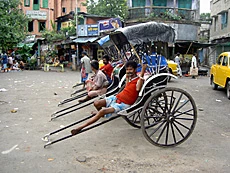
Tourists love photographing them. You can recognize them by their appearance — sunken cheeks, skinny legs, blood-shot eyes (usually from consuming country liquor called, ‘tari’), worn out. They look much older than their real age and many have tuberculosis. They are a dying breed, the rickshaw drivers of Calcutta, often referred to as ‘human mules.’ Arab News visited Calcutta’s infamous Kali Ghat. A row of rickshaw drivers sat there waiting for passengers and eager to talk!
Sixty-year-old Dharmendar Singh has been pulling rickshaws for over 30 years. In a sad voice, punctuated with sighs, Dharmendar recalled his entry into the rickshaw trade. “I did my intermediate from Hajipur’s R.N. College in 1962. I worked for Tata Industries as a clerk. I never dreamt that I would end up like this but who can control destiny?”
Dharmendar Singh’s life took a drastic turn when his only sister was murdered by her in-laws. “They were a wicked lot and beat up my sister for the least offense. One day they beat her so much that she died. When I heard the news, I suffered a nervous breakdown.”
Medical treatment got Dharmendar back on his feet, but he lost his job and nobody would hire him. “I came to Calcutta looking for work and ended up pulling rickshaws.”
Frail looking, Dharmendar works almost 12 hours a day pulling rickshaws. He earns Rs200 per day. He lives in a shanty inhabited by six other rickshaw drivers. He pays Rs. 150 in rent. He sends Rs1000 to his wife who lives in a village in Bihar. “I have six children and I can proudly say that none of them are rickshaw-pullers. They have all matriculated and are employed. Unfortunately, they don’t make enough so I have to continue working, though I’m old and my body hurts a lot.”
Rickshaw drivers are famous for consuming tari. Isn’t drinking and driving hazardous? Dharmendar blushed and with a shy smile said, “Tari is a rickshaw driver’s friend. It is the petrol in our engine. I don’t drink much.” He spends between Rs50-60 on tari every day.
Shanti Devi was standing close by and listening to our conversation. “Talk to me; I’ve something to add to your story,” she invited herself and began talking.
She was from a Bihar village and was married at 12. Her husband, a rickshaw driver, brought her to Calcutta. Both have lived on the footpath since. Shanti works as a daily wage laborer. “I have to support myself. My husband spends all his income for drink. It’s not easy being a rickshaw-puller’s wife,” Shanti said, pointing to a small bundle. “This contains all my belongings. I leave it with a shopkeeper for safe-keeping when I go to work. At night we play hide-and-seek with the policemen. Sometimes we get away but often we end up paying a bribe of Rs.40-50 so we can sleep on these footpaths.”
Shanti Devi has one son who drives a taxi but he gives no money to his parents. “He is a cabbie, he makes more money and the more he makes, the more he drinks.”
Gopal Paswan is from Darbhanga, Bihar. He has been a rickshaw driver for five years. He used to be a field worker but he lost his job when the land owner died. Paswan works very hard and earns Rs200-300 per day. He is the sole provider for his family of 15. He looks at least 50 years old but he swore he was only 40. He looked unwell, coughing constantly. “Pulling a rickshaw is very hard on the body. Customers are always in a hurry, you have to run fast but I’m illiterate and don’t have many choices.”
Eighty percent of the rickshaw pullers in Calcutta are from the neighboring state of Bihar. Why is that?
“Only a Bihari can do such hard work, a Bengali (Calcutta native) cannot.” Dharmendar Singh said proudly and for a moment his weathered face lit up. “What has Bihar given us except sorrow and starvation?” Gopal Paswan said like a philosopher, “A Bihari is pulling rickshaws in Calcutta because Bengal’s bread is written in our destiny.”
The rickshaw pullers of Calcutta are a dying, ever- decreasing breed. There are rumors that the Indian government will ban rickshaws. Calcutta’s metro is faster and cheaper. (A rickshaw’s minimum run is Rs.8) Dharmendar and Gopal were unperturbed. “As long as these old alleys exist and as long as it rains in Calcutta, no government can stop us. We’ll be here as long as we want, not the government,” Gopal said sounding once more like a philosopher than a rickshaw driver.