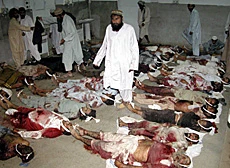
ISLAMABAD, 8 October 2004 — At least 40 people attending a memorial service for slain Sunni extremist Azam Tariq were killed in a bomb explosion early yesterday in the eastern Pakistani town of Multan. At least 100 more were injured in the massive explosion which police said was triggered by remote control as the participants were dispersing at the end of the service at Rashidabad, a residential area of Multan.
The bombing came less than a week after a suicide attack left 31 people dead at a Shiite mosque in another eastern city, Sialkot.
The government announced a ban on religious and political gatherings nationwide after the attack. Interior Minister Aftab Ahmad Khan Sherpao told reporters here that the ban on public gatherings — except for Friday prayers — had been imposed to prevent any more attacks by terrorists. He did not say how long the ban would last.
Police tightened security in other cities. In Karachi, the scene of sectarian attacks and unrest in May, extra police were deployed at mosques.
Yesterday’s bloodshed happened before dawn. A Suzuki laden with explosives went off near where some 3,000 people had congregated overnight to mark the anniversary of the death of the leader of the outlawed Sunni radical group Sipah-e-Sahaba.
Two minutes later, what appeared to be a second bomb attached to a motorcycle went off, deputy city police chief Arshad Hameed said. Most of the injured were taken to the Nishtar government hospital. Fifty of the injured were in serious condition. Outside the hospital an angry crowd of 200 raised slogans against the government and Shiites. The protesters also attacked two ambulances, shattering the windscreens with sticks. Nearby, others burned tires.
Pools of blood and shoes of the victims were scattered at the scene, near the charred remains of the car.
Jamil Usmani, 26, who had been standing in a nearby parking lot with friends, said a stampede after the bombing caused many injuries. “The explosion numbed our ears, we saw people falling on each other, everybody was crying, everybody was running,” he said. “Many people were injured in the stampede, we started picking them up and asked passing cars for help.”
Officials said about 1,000 police, including reservists, were called from other districts, and soldiers were patrolling the city to stop Sunni and Shiites from clashing. Multan has suffered sectarian violence in the past.
Schools and colleges in Multan were closed for two days to stop potential student protests over the bombing, said Ijaz Chaudhry, a senior government administrator.
— Additional input from agencies