
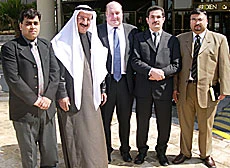
ALKHOBAR, 1 March 2005 — Their current business cards show the PeopleSoft logo. In years past, JD Edwards might have been mentioned, too. For the future, it is likely that the Oracle brand will appear prominently on the visiting cards and brochures passed out to prospective clients by the team of Al-Falak’s Enterprise Resource Planning (ERP) Division. It’s a time of upheaval and consolidation among ERP providers. Local partners and integrators must cope up with the environment and hold their clients’ hands while the international vendors fight it out behind closed doors. Al-Falak Electronic Equipment and Supplies (www.alfalak.com) has been serving the Saudi community for 25 years and in that time has seen many solutions providers come and go in the market.
“We have been through a lot of mergers and acquisitions with the vendors we represent,” said Al-Falak’s President and CEO Ahmed A. Ashadawi. “We have noticed that there are two reasons why companies acquire other companies — for technical reasons and for financial reasons. The basic idea of the acquisition is to gain customers. If I’m going to acquire new customers I have to work to keep them happier than they were before. If I don’t, this defeats the idea of the acquisition. In my experience, in an acquisition the customers’ interests are always kept in mind because the customers are the jewels.”
Ashadawi expects that the recent acquisition of PeopleSoft by Oracle will be a benefit for ERP customers in general. He believes that Oracle will push to make PeopleSoft and JD Edwards applications more comprehensive and effective while bringing down the price of the applications.
“With this acquisition there are two advantages coming,” he explained. “There is a technical advantage because Oracle is adding to and enhancing its capability as a vendor. Additionally, Oracle has worked to cut overhead in the acquisition. This will reduce application cost. Oracle has to compete with SAP and other vendors so they need to bring their costs down. Who benefits from this? The customer. Customers interested in ERP should not put their plans on hold. When people invest in ERP they are investing in their own people and their own company. There is no reason to wait or slow down in considering ERP solutions because companies who acquire other software firms have an obligation and desire to keep up and perhaps even surpass their competitors.”
Al-Falak feels it is operating from a position of strength after the takeover of PeopleSoft by Oracle. Ashadawi pointed out that there are many small Oracle distributors in the Saudi market but that with JD Edwards, Al-Falak was the exclusive representative. Consequently Al-Falak is coming to Oracle with a large size as a company in terms of people, experience and the number of installations. Ashadawi is very positive about the merger and for the near future, he doesn’t believe that there will be much change in their operations.
“To my knowledge today we are still PeopleSoft and we are accredited by PeopleSoft and JD Edwards to implement the systems,” he said. “Vendors don’t rock the boat when they acquire companies. They only do very careful gradual enhancement or work to make systems integrate. So Oracle is going to take a careful approach to this. For some time, we will be operating as we have been.”
With that in mind, what does he see as the potential for ERP implementations?
“I see a trend to go ERP in this market and worldwide,” Ashadawi commented. “In Saudi Arabia we employ expatriates and they get trained here. We noticed that in the area of ERP we are losing expatriates to India because we train them here and we lose them to India. Al-Falak lost three people last year who were JD Edwards trained. In India companies are now very strong on ERP implementation so this is not just a trend here, it is worldwide. Companies that want to survive and compete must implement ERP. There is no other choice. If you look at the concept of ERP, these are systems that smoothly pass information to each other. If you talk about distribution — which is inventory control, sales, purchasing, financial and manufacturing, if you have the flawless movement of information reducing or eliminating the involvement of people, you get speed, efficiency and accuracy. Now with the Internet, ERP is more effective today than in the past. You could be holding a PDA on the road and passing information and receiving information from any of the ERP systems that exists in the company. Sales people on the road can query inventory and financial systems wirelessly from almost anywhere. If ERP has not been implemented, it will be a problem. Any query would have to be done manually and that would take time and be inefficient.”
In the past in the Saudi market, there have been some disastrous ERP implementations. Ashadawi asserted that successful ERP implementation is usually a result of cooperation and teamwork between the vendor and the customer. “ERP implementation is a joint effort,” he said. “It’s not a contractor-client relationship.” Additionally he advised that the commitment to implement ERP must come from the highest levels of management and that management must show continuing support for the process, through the training and operational phases of the implementation, and beyond, or the company would ultimately fail to reap the highest return on its investment in the technology.
That stated, Ashadawi agreed that ERP might not be for everyone.
“The bottom line is that you don’t change for the technology. You change because you need to. If your company is happy, competitive and profitable using paper then they should continue to do so. At Al-Falak we don’t sell technology for the sake of technology. We sell solutions. That is how we approach the market. If somebody doesn’t need a system then we will tell them so. We will say that the way they are doing business is fine and they should stick to it.”
Ashadawi believes though that with time more and more firms will turn to ERP simply because they need to compete if they want to grow.
“Companies have to make sure that they make changes to their own way of doing things before the competition. This is what best business practices are all about. I think the way ERP is going to improve and become essential is by being more web enabled. People are on the road or on the factory floor and they need the data. Small businesses will need to use ERP because it will make them more efficient and more customer responsive. If a customer comes in and wants a product and you have to go to the storeroom and see if you have it or you have to check with the workshop to see if his equipment is fixed, your business is in trouble.”
The choice to do ERP may be straightforward these days but the selection of a solution can be challenging. Ashadawi has found that the sales cycle is much longer in the Middle East than in the west. This can cause frustration among vendors and increase costs.
“People here take their time to take decisions,” he said. “They are cautious in making the ‘right’ choice and that is their right. Companies who want to retain customers must learn to work with them. Customer retention implies good service, proper training and proper technical capabilities. These days the way customers search for information about products and solutions has changed. The Internet allows them to reach out to international vendors directly. This leaves the local firms sitting between the vendor and the customer. So we must look for new ways to add value to the relationship. Otherwise, we should get out of the way.”
(Comments to: [email protected].)