
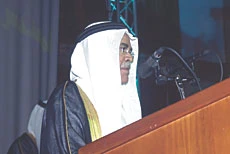
JEDDAH, 6 March 2005 — Arab countries could improve their economies by tapping their own resources. “The Arab world has abundant resources of good quality and with consistent and proper exploration they could compete with the rest of the world,” Minister of Petroleum and Mineral Resources Ali Al-Naimi said here yesterday
“In fact, the Arab countries should be able to meet all of their needs for raw materials,” said Al-Naimi at the inaugural session of a three-day seminar on “Mineral Investment Horizons and Opportunities in the Arab Countries” at Jeddah Hilton.
With the forging of cooperation among the Arab states, there could be better exploration of mines, said Al-Naimi who also later opened an exhibition of products and services in the mining industry.
“The mining industry in the Arab world could attract increased investments from both domestic and overseas investors and thus reduce its dependence on import of mineral resources that they are richly endowed with,” the minister said
Makkah Gov. Prince Abdul Majeed’s message for the success of the event was read on his behalf.
“Creating a trade system and updating the Arab market for the exploration and utilization of minerals could encourage and help the private sector,” he said.
Al-Naimi said “lots of resources are yet to be discovered. Cement, limestone and other mining sectors locally will help to substitute foreign products with our own domestic ones,” he added. Aside from the Kingdom, he named Morocco, Jordan, the United Arab Emirates, Mauritania and Oman which have abundant mineral resources.
The minister referred to the Kingdom’s exploration of gold, copper, zinc and other mines, and said there was vast scope for expanding the operation. The Arab countries could also contribute to creating jobs for their population through increased and improved exploration of mines.
Amr Al-Dabbagh, governor of the Saudi Arabian General Investment Authority (SAGIA), said new transport projects worth more than SR50 billion, including a 2,000-km railway expansion project, would boost mining activities in the Kingdom.
“SAGIA has given priority to investments in the energy sector and related industries such as mining. We’ll do our best to create a suitable atmosphere to attract investments, providing all services required by investors,” he said.
Al-Dabbagh said the Kingdom was pinning great hopes on the mining sector to make it the “third pillar” of economy after oil and petrochemicals. He expected the sector’s contribution to the gross domestic product would cross nine percent.
More than 30 minerals have been discovered in the Kingdom, of which 15 are available in commercial quantities. Phosphate reserves in Jelamaid and Um Al-Wael are estimated at 3.1 billion tons, making Saudi Arabia the largest source of phosphate in the world, he pointed out.
Abdallah E. Dabbagh, president and chief executive of the Saudi Arabian Mining Company (Maaden), explained his company’s position on the mining investment opportunities in the Arab countries. “The mining industries will help support the Kingdom’s economy,” Dabbagh said.
He said the Kingdom’s strategic objectives were to diversify the national economy, generate new sources of revenues, raise the gross domestic product (GDP), create employment opportunities, stop or reverse migration to the cities, balance various regions’ development and transfer technology and management expertise.
A working paper presented by Dabbagh highlights the objectives of Maaden, which conforms to the national goals with a broad based government support. Maaden is being honed to become the third leg of the Kingdom’s industrial and economic development after Saudi Aramco and Saudi Basic Industries Corporation (SABIC), he said.
Maaden, a joint stock company with a capital of over $1 billion and assets of over $1.3 billion, has mounting projects worth over $7 billion for bauxite, phosphate and industrial mineral. The company owns six gold mines — four in operation and two being developed. The company, according to Dabbagh, is consolidating all precious metals businesses for privatization.
Maaden is preparing to incorporate a new company comprising its gold business unit, in advance of spinning it off in late 2005 or early 2006. Maaden is also preparing to receive toward the end of March the full feasibility study for the $1.5 billion Al-Jalamid phosphate project, which is being carried out by a consortium comprising Canada’s SNC Lavalin and the US-based Jacobs Engineering Group.
Sultan ibn Jamal Shawli, deputy minister for mineral resource (designate), in his opening remarks said the intensification of exploration of mineral resources could throw up vast investment opportunity for the progress of the 320 million people of the Arab world. “Also climatic factors give lot of support to mining and exploration of resources in the Arab world,” he said.
Tala’at ibn Dhafer Al-Dhafer, director of the Arab Industrial Development & Mining Organization, stressed the need for greater cooperation and coordination among the Arab countries in promoting domestic and overseas investment in the exploration of industrial and mineral resources. He called for the streamlining of laws and regulations on mineral resources in the Arab world for promoting mining, which currently is low. He hoped that the seminar would discuss these and other related issues for attracting investment in mining in the Arab world.
The symposium aims to update investors about the scope of investment in the Arab countries, importance of the mining sector in the economies of these countries, and also the need for coordination in the Arab mineral sector. Thirty scientific papers are being presented. These focus on facts about exploration, exploitation and investment in the mineral sector, available investments in mining, major investment attraction in mining and the scope of development, and rules, regulations and governing laws controlling the exploration and investment in mining.
Field visits are also being arranged for interested delegates who have come from other parts of the Kingdom and from across the Arab world.