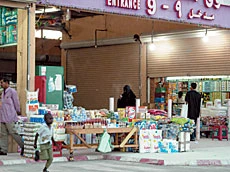
JEDDAH, 7 May 2005 — Tinned and packaged foods are on sale in the Haraj Sawarikh market in the southern suburbs of Jeddah. It is a “free” market; there is no restriction or control on the quality of products sold there.
The market is popular, especially with low-income expatriate workers, because they can buy branded goods at very low prices here. However, many buyers do not know that most of the products are substandard.
Traders often sell old goods after changing their production and expiry dates. “The government should not allow the sale of foodstuff in this market because it’s dangerous to public health,” Muhammad Al-Mubaraki, a visitor to the market, told Arab News.
He urged Saudis and expatriates visiting the market to be cautious about their health. “At the same time, authorities must monitor the market and prevent sales of food products here,” he added.
According to Abdul Kareem Al-Amoudi, expatriate workers have dominated the stallholders in market. “Most of these workers do not possess valid iqamas and they are ready to sell any product,” he claimed.
Amoudi said traders sell food products for less than half the prices offered by supermarkets. The market attracts large crowds of shoppers every day, but especially at weekends.
“Most of our customers are Indians, Pakistanis and Africans,” Ahmed, a trader, told Arab News.
Asked from where the stallholders purchased fake and substandard products, Ahmed said they bought them from importers and wholesalers.
“We purchase them from their warehouses just one or two months before the expiry date at very cheap price,” he added.
Low quality products are being sold in many parts of the Kingdom despite the efforts of the anti-trade fraud panel at the Commerce and Industry Ministry to monitor the market.
Just because a product is past its expiry date, however, does not automatically mean it is dangerous. If a can of food is not dented or damaged, the contents can last for years but may not taste right.
Over time, said Michael Doyle, a food microbiologist at the University of Georgia’s Center for Food Safety and Quality Enhancement, the interaction between the acid in the soup and the lining of the steel could produce sulfur dioxide gas, causing the can to swell.
The pressure and high temperature used in the canning process mean that the contents should remain safe as long as no pathogen enters a damaged can. The product will not necessarily make you sick. The levels of certain nutrients will decrease and the color of the food may change and the food might develop a sulfurous taste because of the production of hydrogen sulfide. If it contains meat, it might smell or taste slightly of ammonia.
If the original expiry dates have been altered, then there is no way to tell the age of the product or judge its safety. Food experts advise that the only really safe course is if the can is swollen or there is doubt about the expiry date, do not eat the contents.
Last year, according to Commerce and Industry Minister Dr. Hashim Yamani, a panel set up to monitor the sale of dated products inspected 144,793 shops selling such expired and contaminated products and took punitive measures against them.