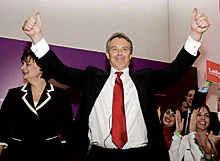
LONDON, 7 May 2005 — A victorious but chastened Tony Blair vowed yesterday to listen to the British people who returned him for a third term as prime minister — but with a much-reduced majority that could strain his authority and drive him from office half way through the term.
Conservative chief Michael Howard, who led his once-mighty party to a third successive defeat, announced his resignation.
Blair, who met senior Cabinet colleagues in the afternoon ahead of a possible government shuffle, saw his Labour Party’s House of Commons majority slashed from 161 to 66 by a volatile electorate disillusioned with politicians and angry over the Iraq war.
“I have listened and I have learned,” he said. “And I think I have a very clear idea of what the British people now expect from this government for a third term.”
Labour needed at least 324 seats to form a majority in the 646-seat House of Commons. With 627 constituencies reporting, Labour had 355 seats; the main opposition Conservatives 197; Liberal Democrats 62; and independents and smaller parties 13.
Voter turnout, at 61 percent, was up 2 percent from 2001’s record low. This was a much more closely fought election, in which both main parties did better than they had feared but worse than they had hoped. The Conservatives added more than 30 seats to their total but failed to make a national breakthrough. As in 1997 and 2001, they lost their leader soon after the election.
“I have said many times since I became leader, that accountability matters,” Howard told supporters in London yesterday. “I have said that if people don’t deliver they go, and for me, delivering meant winning the election. I didn’t do that.”
Howard did not announce a date for his resignation.
Labour won with a substantially reduced majority that could make it harder for Blair to push through planned changes in public services and secure a yes vote in a referendum on the European Union constitution.
Blair reshuffled his Cabinet, keeping Gordon Brown as chancellor of the exchequer. Jack Straw remains foreign secretary, while John Reid becomes defense secretary, replacing Geoff Hoon who becomes leader of the House of Commons responsible for organizing the government’s legislative program.
Patricia Hewitt, who was trade and industry secretary, takes Reid’s old job as health secretary. David Blunkett, forced to resign last December as home secretary, returns to the Cabinet as work and pensions secretary.