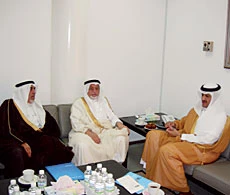
RIYADH, 11 May 2005 — Prince Sultan ibn Salman, chairman of the board of trustees of the Prince Salman Center for Disability Research (PSCDR), received in his office Dr. Abdul Rahman Al-Zamil and Abdul Aziz Al-Zamil of the Al-Zamil Holding Group which has just become a member of PSCDR’s Founders’ Council, according to Waleed K. Al-Deaigy, PSCDR assistant executive director.
The Al-Zamil brothers presented a check to Prince Sultan as part of the SR5 million contribution the Al-Zamil Group is making as the 87th member of the Founders’ Council.
To join the Founders’ Council, one has to contribute SR5 million. The members include government officials, six banks and charitable individuals and organizations.
Al-Deaigy announced that the PSCDR will launch a newborn-child screening program toward the end of this month with the hope of preventing disability among children with metabolic disorders.
“Based on Ministry of Health statistics, the number of children born yearly is about 400,000 and we estimate that we can save about 400 children from diseases caused by faulty metabolism by conducting a screening program,” Al-Deaigy said.
He said the program will not only create a national database but also help the economy.
“If the 400 children that we expect to save become disabled due to an ailment caused by faulty metabolism, the cost of treatment per newborn is SR70,000 annually, according to the Disabled Children’s Association in addition to SR19,000 per night at the intensive care unit,” he said.
The program will be conducted in three phases. In phase one, the PSCDR will receive samples from hospitals for testing 75,000 newborn children in Riyadh.
“Phase 2 and 3 will be a two-stage expansion of the work and by the third year, we hope that we shall have covered the whole Kingdom. We will be using the services of courier firms to deliver the samples to our central laboratory at the King Faisal Specialist Hospital & Research Center,” he said.
He added that under the program pediatricians will be trained in recognizing metabolic disorders such as phenylketonuria. This is due to high levels of phenyl alinine which comes from the mother’s milk. They will also assist in creating awareness of the disorders.
Al-Deaigy said the project aimed to come up with a national system for the identification and treatment of inherited metabolic and endocrine diseases for all children born in the Kingdom and a national system of genetic counseling and information provision to families who have children with metabolic diseases.
“The project also hopes to develop a training program for pediatricians and other physicians regarding detection and treatment of inborn errors and a national awareness program leading to the understanding and prevention of metabolic diseases,” he said.
During the press conference, Dr. Mohamed Rashed, head of PSCDR’s laboratory, and Fahd Badawi, clinical research coordinator for PSCDR’s newborn screening program, explained and described some of the technical aspects of metabolic disorders and fielded questions from the press.