
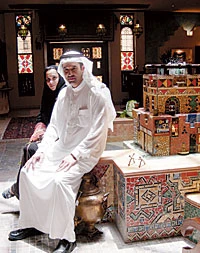
Quickly you walk down the narrow passageway along the side of the building. It’s morning and the sun is hot on your face. The wide wooden door beckons. You pull it open in a rush and hurry inside. And then you stop and breathe. The courtyard is an oasis of calm. Splashing water from the fountain provides instant sensory relief. The sunlight has been transformed from piercing rays of fire to dancing shadows. A light breeze dries the sweat on your brow. You relax into the serene atmosphere and move forward with smile. Welcome to Desert Designs.
Fourteen years after they first began promoting tribal art, Farid Bukhari and his wife, Qamar Ahmed, are welcoming their friends to a place they have built as the permanent home for their vast collection of handcrafted artifacts. The fusion of modern and traditional architecture in the building on Dhahran Road is a head turner. The interior is even more stunning than the exterior. Rowshan and Mashrabiyah draw the eye skyward. Richly textured handwoven rugs cover the floors. The courtyard boasts a fountain like no other. Qamar spent weeks on her knees in the heat and dust of a construction site, with her own hands breaking tiles and plates and then placing the fragments to form the mosaic decorating the fountain.
The intention of the new building is to recreate a village atmosphere where everyone feels at ease. The customers of Desert Design are treated as guests. Everyone is welcomed to sit and drink a “finjan shahi.” There is no pressure to buy. In fact some customers mentioned that they frequently come to “visit” a cabinet, carpet or picture several times before deciding to carry it home or not.
“We want to show people that it can be beautiful to take certain traditional elements and fuse them with modern construction and design,” said Farid. “Over the years by doing many interior design projects we learned what worked well. The goal here at our new location is to be practical and create a pleasurable ambiance while still holding on to our heritage. The dirty antique shop concept has been completely banished.”
Farid believes that Saudi Arabia’s 100-year anniversary celebration was really the first time that the average person in Saudi Arabia considered the nation’s culture and heritage.
“Before the anniversary we were on our way to forgetting our traditions. Sadly we feel that our past was poor. Things then were hard. Once prosperity came people just wanted to abandon all the remembrances of those difficulties. Just tear everything down. Throw all the old things away and start new. The problem with that is that if you don’t know your past, it’s hard to build a successful future.”
Everything that Qamar and Farid did to grow Desert Designs was on their own initiative. No one from any official tourism or cultural authority ever gave them any support or encouragement. Nevertheless their labor of love prospered. They decided that their collection needed to be housed in a larger place that would allow it to be displayed properly. Together with an architect they developed a design for a building that would have elements of Saudi architecture from many of the Kingdom’s regions. Unfortunately, the couple received a terrible shock when the municipality declined to approve the plans.
“The planning board told us, ‘We don’t want this kind of building in our town.’ They didn’t want what they considered to be an old-fashioned two-story structure built on Dhahran Road, side by side with modern steel and marble buildings. They wanted us to remove all the traditional Saudi architectural elements except those found in heritage buildings in the Eastern Province. We refused. In the end after much discussion and a certain amount of negotiation they agreed to the construction. And then you wouldn’t believe it,” Qamar said, with a laugh. “As the building neared completion all those people who tried to block its construction became interested in it and were congratulating us.”
Desert Designs has a focus on offering people treasures for their homes. The priority is on supporting Saudi artists and craftsmen and supplementing that base with unusual handicrafts brought from Morocco, Iran and Kashmir.
“We tell all the artists and craftsmen we deal with not to copy. We want innovative, original work. Every single piece in the shop is handcrafted with taste and love,” Farid said. “Each item was selected by myself, my wife or my brother-in-law. We love this art. We love the nomads and tribal people we deal with. We treat them fairly. We pay them on time and encourage them to do their best. The majority, 85 percent of the art at Desert Designs, is created by Muslims.”
Farid and Qamar see their new heritage center as just the start of a long-term plan to support all aspects of Saudi culture. On the second floor of the new building they hope to have tribal crafts shows and local art shows. They also envision opportunities for local food fests and special youth activities at holiday times. There will be a “Tea Tent” opened soon serving traditional tea and pastries, coffee and dates and other authentic Saudi desserts.
“You can go into a cafe here and get Turkish coffee, cappuccino, espresso and who knows what other kinds of coffee. If you want to drink “gahwa” though, it can’t be found. Isn’t it very strange that one can’t order Arabic coffee in a cafe in Saudi Arabia? That needs to change,” remarked Qamar.
The couple also hope to bring more Saudis into the business, although it’s been difficult to find young people interested in embracing the Desert Designs style of service.
“Our customers like the personal touch,” Qamar said. “Farid is always here. There is a reason for that. We think of our customers as friends. While we want Saudis to join our staff, we would be delighted to see more Saudis here taking an interest in their heritage, too. We have always had many expatriates who came to us to buy Saudi art. Now we are really calling out to the Saudis in the community to step forward and rediscover their own traditions. Let them take home one piece of Saudi art and share it with their loved ones. This is the way to keep Saudi culture alive.”