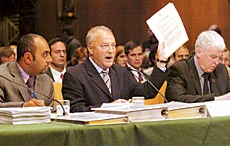
WASHINGTON, 18 May 2005 — Appearing voluntarily but clearly under emotional duress in a packed US Senate hearing room, a defiant George Galloway, the British member of Parliament, yesterday attacked his American accusers for their claim that Iraq illegally awarded him lucrative contracts under the now-defunct United Nations oil-for-food program.
During three hours of testimony that occasionally took on a defiant tone, the newly elected MP lashed out at his Senate questioners, saying they were smearing his reputation and engaging in “the mother of all smokescreens” to hide the real scandal: That American firms themselves had reaped billions of dollars in profits from deals struck with former Iraqi leader Saddam Hussein.
During introductory comments, the chairman of the Senate subcommittee, Norm Coleman (R-Minnesota), alleged that Galloway conspired to use a charitable organization from 2000 to 2003 to launder profits from the sale of 20 million barrels of Iraqi oil.
In his defense of this charge, Galloway declared: “I am not now nor have I ever been an oil trader and neither has anyone on my behalf. I was an opponent of Saddam Hussein when British and American governments and businessmen were selling him guns and gas.”
Testifying under oath, Galloway said the allegations made against him were full of factual errors and false statements: “On the very first page of your document about me, you assert that I have had many meetings with Saddam Hussein. This is false,” he said. “I have had two meetings with Saddam Hussein, once in 1994 and once in August 2002. By no stretch of the English language can that be described as many meetings. In fact I’ve met him exactly the same number of times as Donald Rumsfeld met him. The difference is that Donald Rumsfeld met him to sell him guns and to give him maps the better to target those guns.” As the sharp exchange unfolded, the mood in the packed room was electric with occasional snickers from the audience at Galloway’s jibes at the senators.
Galloway bluntly confronted Coleman and challenged the attorney to back up claims the British MP profited handsomely from the now defunct program. Some of his harshest remarks concerned Coleman’s support for the US-led invasion of Iraq that ousted Saddam.
“Now I know that standards have slipped over the last few years in Washington, but for a lawyer, you are remarkably cavalier with any idea of justice,” Galloway said. Galloway accused Coleman of sullying his reputation and falsely asserting that he gave money to Saddam. “You call that justice?” he asked, adding later: “This is utterly preposterous.”
The MP told reporters later he felt Coleman had failed in his cross-examination. “He’s not much of a lyncher,” he said.
Coleman, in turn, said afterward he did not think Galloway was a “credible witness” and that if he lied to the committee there would be consequences.
A maverick kicked out of the British Labour Party for his fervent opposition to the Iraq war and for personal attacks on Prime Minister Tony Blair, Galloway used the opportunity to criticize the US invasion of Iraq. “Senator, in everything I said about Iraq, I turned out to be right and you turned out to be wrong, and 100,000 people have paid with their lives — 1,600 of them American soldiers sent to their deaths on a pack of lies,” he said.
Coleman, who did not respond to Galloway’s criticism, stuck to questions over the MP’s dealings in Iraq and quizzed him over Iraqi Oil Ministry documents the senator said showed he received oil allocations.