
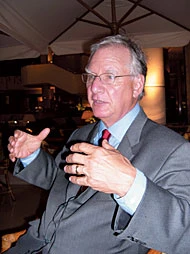
ALKHOBAR, 20 May 2005 — In the announcements for his May 16 seminar held ad King Fahd University of Petroleum and Minerals (KFUPM) he was billed as “The Guru of Gurus of Management.” Tom Peters was in town to present “Re-imagine! Business Excellence in a Disruptive Age,” a seminar based on his 2003 bestseller “Re-Imagine.” Slides from the presentation are available at www.tompeters.com.
Peters burst on the scene in 1982 with “In Search of Excellence,” and quickly made a name for himself in the area of business management. Decades later, while there has been some criticism of Peters’ early ideas, the man himself has continued to be enormously popular, and regularly presents his ideas to packed seminars the world over.
In defense of his early thoughts on business management Peters pointed out that “Excellence is not forever.” He did however mention that on the 20th anniversary of “In Search of Excellence” Forbes Magazine ran a piece investigating the return on shares in all the publicly traded original “excellence companies.” This “Excellence Index” wildly outperformed the market in general.
“Eighty percent of those original firms are still doing okay,” Peters said. “The half life of a company’s excellence is not what it used to be. Companies are now exiting the Fortune 500 at a rate that is something like four times higher than the rate it was in the 1970s. The churn among sizable institutions is increasing. Churn is to be expected among new restaurants but not among companies that have made it to the Fortune 500.”
While Peters is not a professional economist, his concept of “destroy to create” is the centerpiece of his economic thinking.
“I think a lot of the secret of America’s sustained economic success is that with rare exceptions we don’t save institutions that are dying,” Peters remarked. “We do everything we can with financial markets and so on to make sure that there are enough startups that we get the occasional Google or Microsoft. I believe that small businesses clearly should receive government encouragement. By this I mean that the government should create the financial measures that make it easier to invest in small businesses. The small businesses sector in the US is not only a product of a pretty inventive spirit but of an incredibly vital financial services market.”
This is of course quite a difference from the financial services market in Saudi Arabia where lending to small firms is unheard of and more in the nature of personal loans than any sort of business startup capital. That’s not to say that the economic situation in the United States is congenial, at least from the worker’s perspective. Peters is of the opinion that the concept “You and only you are responsible for your career,” is more important than ever.
“Job certainty is gone. Even in Japan it’s not certain anymore,” explained Peters. “Until 15 years ago it was the average American’s expectation that if you got the university degree and had done modestly well or better, you’d go to work with Citigroup or ExxonMobil and that would be it. You would live literally happily ever after because decent benefits would follow you into retirement. This has disappeared. As we all know from the news, it hasn’t disappeared quite so much in Germany yet. But Chancellor Schroeder wishes it would disappear, even though he is a Social Democrat. So this is a generic movement that is driven primarily by the phenomena of China and India’s two billion people being unleashed on the global economy, plus technology. There are a great deal of white collar jobs where people are being replaced effectively by microprocessors. What you do to counter that starts at the age of five not at the age of 45 because in a world where the mechanical tasks will be taken over either by inexpensive labor from somewhere else or a mechanical device like a microprocessor, the work that’s left is relatively creative work. Whether it’s the Saudi system, or the British system, or the American system, or the Japanese system, schools push the risk taking out, they push the creativity out and that has to change.”
Peters did agree that innovation is more of a culture than an idea and he has found that companies who innovate best are the ones which have always been the most innovative.
“I think that there are techniques that can be learned, employment practices that can be adopted and strategies that one can become more serious about, but statistically the odds of turning a sow’s ear into a silk purse are very low,” said Peters.
One area where it might have been hoped that Peters would encourage change in Saudi Arabia would have been in the role of women in the economy. Peters has written a book, “Women Roar.” His own promotional material for the publication touts, “The evidence is clear! Women are better leaders than men under the conditions of the new economy. Women are the world’s biggest market opportunity by far and are wildly underserved.” That stated, it was a disappointment that Peters refused to discuss women and the economy in the Kingdom.
“I have avoided this issue in its entirety. I do not avoid it when I’m in a Dubai or Bahrain. Certainly not in Malaysia. The situation is extreme here. I’m not being cagey with you. I’m a wild eyed advocate of women when I’m home and I’m a pretty heavy advocate in other parts of the world. There is a line here that I’ve chosen not to cross. My instinct is to go across it. But I won’t.”
He did feel that there was a lot of transition required in the Saudi economy and he was concerned that the current high oil price might put off some of the hard work that needed to be done. He was quite emphatic that the Kingdom should not be complacent.
“I would count myself among those who think that the odds are on OPEC and Saudi’s side that these prices are going to stay for a while. The situation here is a planetary rarity. There is a window of opportunity. Look at what Texas did when the first oil shock came in 1973. The government in Texas took the money they earned from taxes on the oil companies and threw every penny of it into higher education. Texas today is a hotbed of technology and innovation and startup companies. The event today was sponsored in part by KFUPM so particularly in some of the breaks the discussion surged around education. There was almost uniform agreement that something ought to be done. The question is, will anything be done?”