
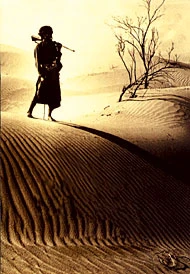
Arabian Sands by Wilfred Thesiger, one of my favorite books on Arabia, was first published in 1959. A second edition appeared in 1983 and I have just found that a third edition was published by Harper Collins in 2000. I happen to have a copy of this last edition and I was pleasantly surprised to see that the quality of the stunning black and white photographs are much clearer than in the first edition. Arabian Sands has been hailed as the last great book on Arabian travel. It is definitely a classic of the ‘genre‘ but it is also an impassioned ode to the Bedouin life style which is already almost extinct.
When Thesiger visited Saudi Arabia in 1946, he realized that he was able to cross the Empty Quarter “just in time” to capture the spirit of the land: “Today the desert where I traveled is scarred with the tracks of lorries and littered with discarded junk imported from Europe and America… In the desert I had found a freedom unattainable in civilization: A life unhampered by possessions, since everything that was not a necessity was an encumbrance. I had found, too, a comradeship inherent in the circumstances, and the belief that tranquillity was to be found there. I had learnt the satisfaction which comes from hardship and the pleasure which springs from abstinence: The contentment of a full belly; the richness of meat; the taste of clean water; the ecstasy of surrender when the craving for sleep becomes a torment; the warmth of a fire in the chill of dawn.”
Details of both his crossings of the Empty Quarter — or the Sands as they are also known — make fascinating reading. The author’s keen observations, entertaining thoughts and sense of humor make up for the barren and often desolate landscape. This southern desert stretches for nine hundred miles from the frontier of Yemen to the foothills of Oman, and for five hundred miles from the southern coast of Arabia to the Arabian Gulf and the borders of Najd: “The greater part of it is a wilderness of sand; it is a desert within a desert, so enormous and so desolate that even Arabs call it the Rub Al-Khali or the Empty Quarter.”
The compelling description of the dunes betrays deep feelings for the desert’s awesome beauty. Even when he is tired, hungry and thirsty, their shapes gave him “great pleasure.” He notices how the surface of the sand is a smooth combination of heavier and darker grains and lighter pale-colored grains: “It is the large grains which give the prevailing hue to the landscape. Disturb the surface of the sand
and underlying paleness is immediately revealed. It is this blending of two colors which gives such depth and richness to the sands: Gold with silver, orange with cream, brick-red with white, burnt-brown with pink, yellow with grey, they have an infinite variety of shades and colors.”
Throughout his travels, Thesiger praises his Bedouin companions. Without their help, he knows, he would never have lived to cross the Empty Quarter: “If I traveled here alone, the weight of this vast solitude would crush me utterly.”
He admires the Bedu’s patience, their generosity, loyalty and courage: their ability to drink bitter water, eat little food and put up with freezing cold in winter and burning heat in summer without shade or cloud. During one of his journeys through the sands, Thesiger recalls how once near a well, his companions cooked a large pot of rice but the water had such a foul taste, no one ate the food. The Bedu who live in the Empty Quarter are accustomed to mix water with sour milk, and this beverage they call ‘shanin; it enables them to drink water which would otherwise be undrinkable. Like his Arab companions, he doesn’t fail to appreciate the great qualities of the camel. He remarks that many Englishmen have written about camels but that their actual knowledge of them is slight. A Bedu calls a camel ‘Ata Allah’ or ‘God’s gift’ and has a genuine affection for this animal. The Bedu are not afraid of thirst or hunger; they claim they can ride in cold weather for seven days without food or water but if ever they lost their camels, they fear the certainty of death.
Every time I read Arabian Sands I am carried away by Thesiger’s love for the Bedu and the desert of Arabia. He himself confessed that after leaving Arabia, he traveled to the Karakoram and the Hindu Kush, the mountains of Kurdistan and the marshes of Iraq but none of those places moved him as did the deserts of Arabia: “In the deserts of Arabia there is no rhythm of the seasons, no rise and fall of sap, but empty wastes where only the changing temperature marks the passage of the years. It is a bitter, desiccated land which knows nothing of gentleness or ease. Yet men have lived there since earliest times... Men live there because it is the world into which they were born; the life they lead is the life their forefathers led before them; they accept hardship and privations; they know no other way. He will carry, however faint, the imprint of the desert, the brand which marks the nomad; and he will have within him the yearning to return, weak or insistent according to his nature. For this cruel land can cast a spell which no temperate clime can match.”