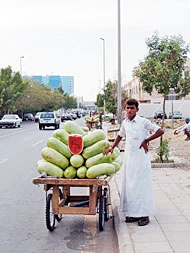
JEDDAH, 29 May 2005 — People have been having problems with fruit ever since Eve ate the forbidden apple in the Garden of Eden. Cross the sands of time to modern-day Jeddah and you’ll find the healthy, nutritious bounty is still causing trouble, but this time street-peddling fruit vendors are the problem.
The cart-pushing peddlers sometimes snarl traffic and have store owners snarling because of the business they lose to the low-overhead operations. Some people suspect the fruit the peddlers sell is not wholesome while there are others who eat it every day.
As many of them are illegal immigrants, Jeddah residents often get to watch exciting chases as traffic police and officers from passports and immigration departments try to bag the vendors before they can bag the fruit. So goes the story of the fruit people of Jeddah.
One chase, which was witnessed by several motorists, including this journalist, took place in the empty lots behind Toyland on Tahlia Street last week. No one was arrested.
“The police chase them several times a week — sometimes more than twice in a day. They run away and come back when the police are gone,” said Saleem, a repairman whose shop is located opposite from where the vendors set up their carts.
“When they see the police coming they start walking toward the middle of empty lots away from the street. The closer the police get, the faster the fruit people walk. They usually start running when the policeman gets out of the car and seem to always have a far enough headstart because they are rarely caught.”
In Al-Rawdah district, the fruit people are part of the streetscape. Some residents interviewed by Arab News complain that police there do nothing to stop their illegal commerce.
Galal Al-Ghamdi contends they are annoying and damage the streets. He considers the fruit carts a danger for motorists and pedestrians.
“We’ve complained may times, but our voices are unheard by officials,” Al-Ghamdi said. “Every Friday, they gather outside mosques and block the entrances just to sell their fruit.”
He said fruits should be stored in a cool place and refreshed by water. Peddlers display their fruit for long hours in sunshine that can reach 40 degrees Celsius. “Police should do something and seize their fruit before it poisons people,” he added.
Not everyone considers the peddlers a menace.
“I don’t know why people complain about them when they provide service to our door,” said Medhat Salem, a resident from Egypt. “The problem is that they have no permits to sell fruit, but they aren’t harming anyone. Jeddah market is big enough to hold everybody, and no one is harming anyone’s business.”
Medhat dismissed health hazards, saying that he has bought from the peddlers for a very long time. He sees no difference between their fruit and fruit sold at the market.
At the other end of the cart, Arab News met with fruit peddlers in front of the girls’ middle school in Al-Rawdah.
Mansour Ali, a Yemeni peddler, denied their fruit came from suspicious sources. He said they get their fruit either in bulk at the fruit market each morning or straight from farm sellers.
Ali comes from a very poor family in Yemen. He has nine brothers back home — two in the army and the rest unemployed. He crossed the border two years ago and has been working in Jeddah ever since.
“Life is very difficult back home, and I am relying on this job to support my family,” he said. “The business is good, and I am making good profits. I have my own customers now who rely on me for their fruit. When we are selling, we have lookouts who watch for municipality cars and warn us.”
He said he’s avoided capture twice during municipal raids in Bani Malik area, but all his fruit was seized.
A storeowner, who did not want his name used, said fruit peddlers harm the retailers.
“If the situation continues like this then I will go out of business very soon,” he said. “For example, I sell one kilo of lemons for SR6. These fruit peddlers sell it for SR3 per kilo. And they do that to all fruit I sell. I saw a police officer, in uniform, driving a police car, buying from them instead of arresting them. This is something I don’t understand and will never understand.”
Police do chase the fruit people; however, and sometimes they get orders to make the peddlers’ lives as bittersweet as a tart lemon.
“The only reason we bother with them is that they block traffic, and people complain,” said police officer Mishaal Al-Zahrani, catching his breath after a chase. “By harassing them enough, we slow down their business and stress them out. Eventually they move on to a different spot.”
It’s a game of cat and mouse.
“We generally don’t like to take them in because of the headache involved, but when orders come from above, we have to follow them. Right now, our main function is to clear the road for traffic and make life a little difficult for them,” Al-Zahrani said.
For the group of Yemenis chased yesterday by the police, life is already difficult enough. Their day begins at the Halaga, Jeddah’s largest fruit and vegetable market located off the Makkah Highway in the Safa district, just after Fajr prayers. There, each one of them spends SR500 on watermelons and mangoes and makes his way to where his cart is located — usually hidden — not far from where the trading takes place. “By the end of the day I usually make between SR60 and SR80 profit. But when the fruit is taken after a ‘no-joking’ raid, we lose a week’s worth of profit. But at least we have our freedom to start again somewhere else,” said Muhammad, 34.
According to police officer Al-Zahrani, it is not the police that the vendors are really worried about, but the Passports and Immigration Departments. The two departments have several methods for catching the fruit people.
According to a source there, the favorite involves several undercover immigration officials in their own personal cars.
“They pull up to a group of vendors to buy some fruit. As all the agents are haggling over the price with the vendors, a discreet signal is given, and each one is arrested on the spot — by his “customer”. They are then held there until the Passports Department vehicle comes moments later to pick them up,” the source said.
According to the fruit vendors, deportation to Yemen can takes anywhere from several weeks to a few months. Saleem told Arab News although he hadn’t seen the Passports Department coming around for several months, when they did come, “things definitely changed.”
If the police don’t confiscate the fruit, the fruit people come back and start selling again once the police drive away. If the police take the fruit, the fruit people come back for their carts and leave.
Most of the time, that is.
“I remember a few months ago, I came out of the store, and the carts and the fruit were there as usual, but the fruit people were gone. I thought they would be back in 45 minutes, but when I saw a Passports Department vehicle come and load up all the fruit, I knew they had been busted for real,” said Saleem.
No more daily police chases — for a while.
“The carts stayed out by the roadside for a few days; then some other people came and made use of them for a day and took them as their own,” Saleem said. “It’s actually the same group that is here now.”
According to Muhammad, replacing the fruit cart is never really a problem. “It takes me two days to make one. I can make one for you for SR500 if you like,” he told Arab News.
Are the fruit people poised to become the cart people? We’ll keep you posted. See what trouble eating one little apple can start?