
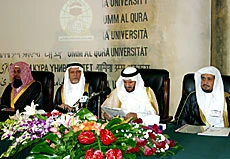
JEDDAH, 1 June 2005 — More than 130 experts from Saudi Arabia and other Muslim countries are expected to debate nearly 50 research papers at the third Islamic economic conference, which was opened at Um Al-Qura University in Makkah yesterday.
In his inaugural address to the conference, Prince Sultan, second deputy premier and minister of defense and aviation, emphasized Saudi Arabia’s efforts to get along with international economic developments.
“We have adopted a series of economic reforms and regulatory measures. For example, we have modernized regulations of foreign investment, reorganized the capital market and are holding negotiations to join the World Trade Organization,” the prince said.
Prince Sultan also spoke about the Kingdom’s privatization drive by selling out shares of state-run corporations to Saudi citizens through initial public offerings (IPOs). He was referring to the IPOs of Saudi Telecom and the National Company for Cooperative Insurance (NCCI).
In his address, which was read out by Abdullah Al-Faiz, undersecretary at the Makkah governorate, Prince Sultan noted Saudi Arabia’s pioneering role in promoting Islamic economics. “We believe that economics is part of the comprehensive Islamic system,” he explained.
In his welcome address, Dr. Nasser Al-Saleh, president of Um Al-Qura University and chairman of the organizing committee, thanked Prince Sultan for bearing all the expenses of the three-day conference. He said Um Al-Qura organized the event shouldering its responsibility in addressing modern economic and social issues.
Dr. Muhammad Al-Oqla, undersecretary at the university for higher studies and research, emphasized Saudi Arabia’s role in promoting Islamic economics by establishing departments for the subject at its universities.
Dr. Saud Al-Shuraim, dean of the College of Shariah and Islamic Studies and imam of the Grand Mosque, said the conference would discuss economic problems faced by Muslim countries, the progress of Islamic economics in theory and practice, and the challenges being faced by Islamic financial institutions from globalization.
The first conference on Islamic economics was held in Makkah 30 years ago and was attended by more than 200 economists and researchers.
The second conference was held at the Islamic University in Islamabad, Pakistan, on March 19-23, 1983 and debated 24 research papers on Islamic economics, Islamic banking and Zakat system.
According to Dr. Nasser Al-Saleh, the current conference will have 11 working sessions with papers presented by 132 experts including 57 from outside Saudi Arabia. He said the conference would discuss the effect of free trade and other modern developments on the economies of Muslim countries.
The first session of the conference, which was held yesterday, emphasized the need to tighten supervision of Islamic financial institutions including Islamic banks. It also dealt with the challenges facing Islamic banking.