GAZA CITY, 5 June 2005 — President Mahmoud Abbas yesterday postponed Palestinian legislative elections indefinitely, drawing an angry protest from Hamas.
In a public decree, Abbas said he had decided to postpone the July 17 poll to allow time to resolve a dispute over proposed reforms to the voting law.
Hamas called the postponement a “violation of the Palestinian national interest” and of understandings it reached with Abbas to abide by a truce he declared with Israel in February.
“It is clear the decision to delay the poll was a result of narrow party considerations,” said Mushir Al-Masri, a Hamas spokesman in Gaza, referring to Abbas’ mainstream Fatah faction.
Fatah officials said last week the parliamentary poll was likely to be put off because of discord within the party over reforms to the voting law sought by Abbas to give smaller factions like Hamas a better chance of gaining seats.
Abbas has encouraged Hamas to enter mainstream politics in the hope of shoring up the fragile four-month-old cease-fire and broadening his popular mandate for peace talks with Israel.
“The Legislative Council did not finalize the election law and we are running out of time,” Abbas said after issuing the decree.
“Therefore, the election should be postponed until the legal procedures and consultations are complete, and after that a new time will be set,” he said.
Hamas accused Abbas of trying to improve Fatah’s chances with the delay.
“This decision was taken unilaterally... and it came as a response to the conditions and the atmosphere of the Fatah movement and not because of any national consideration,” said Sami Abu Zuhri, a Hamas spokesman in the Gaza Strip.
While accusing Abbas of violating understandings of the cease-fire agreement, Abu Zuhri indicated that Hamas would continue to honor the truce. He said only that Abbas’ decision “might harm the credibility of relations” with Hamas. Tapping into voter dissatisfaction over years of Fatah corruption, Hamas has captured a number of key races in recent local elections and appears poised for strong gains in the legislative vote as well. It is the first time it will participate in legislative elections.
Abbas reached the cease-fire agreement with Israeli Prime Minister Ariel Sharon on Feb. 8 in an effort to end four years of fighting. Hamas and other armed groups agreed the following month to honor the truce in return for pledges from Abbas to give them a formal role in Palestinian decision-making. Violence has dropped sharply since then.
The delay could give Abbas time to hold Fatah primaries, which he believes will yield stronger candidates, and allow him to capitalize on Israel’s planned withdrawal from Gaza in August. The withdrawal could also bolster Hamas, whose stronghold is Gaza.
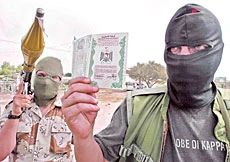
The fragile security situation in the occupied territories was highlighted yesterday when Fatah gunmen, demanding jobs in the Palestinian police force, blocked a Gaza road to the Egyptian border and detained a Palestinian diplomat hoping to cross.
Shaker Abu Eida, the Palestinian ambassador to North Korea, said by telephone he had not been harmed and that he would be allowed to return to Gaza City if he wished.
The 35 gunmen, many of them masked, stopped the envoy as he made his way to the Rafah border terminal and said he and any other Palestinian officials would not be able to enter Egypt until their demands were met.
— Additional input from agencies