BAGHDAD, 10 June 2005 — Iraq’s Sunnis yesterday won greater role in the country’s politics, but the exact number of their representation in the committee drafting a constitution remained unclear.
Leading officials in the committee tasked with writing the constitution by Aug. 15 said the size of the committee would be expanded to 69 members from 55. The number of Sunni Arab members would be raised to 15 from two, giving them the same level of representation in the body as the Kurds.
The Sunnis, however, have demanded more. On Wednesday an alliance of Iraq’s main Sunni Arab groups said they wanted 25 seats on the constitutional committee and would refuse to take part in drafting the document unless their demand was met.
President Jalal Talabani said the Sunnis had been allotted 25 seats but Prime Minister Ibrahim Jaafari said there would be 14 extra places. That was in line with the comments by parliamentary officials directly involved in talks, who said 13 would go to Sunnis and one to another, small sect.
A Sunni legislator on the committee said that although an agreement had been reached on Sunni Arabs joining an expanded and parallel committee, no deal had been struck on their number.
Adnan al-Janabi, one of two Sunni Arabs on the committee, said Sunni groups have agreed to join the 55 legislators in an expanded body whose decisions would be taken by consensus. The decisions would then be referred to the 275-seat National Assembly. Al-Janabi, who has led contacts with the Sunni Arabs about their representation, said there has been no agreement on the number of representatives to be involved in the process, but added that Parliament, in a goodwill gesture, would issue a resolution “recognizing and supporting” the expanded committee when it is formed.
Sunni Arabs dominated Iraq during Saddam Hussein’s rule but were sidelined by Jan. 30 elections which propelled Shiites and Kurds into power. Many Sunni Arab groups called for a boycott of the elections and most Sunni voters stayed away from the elections.
Iraq’s government says it will offer Sunni Arabs more participation in politics to try to defuse sectarian tensions and undermine the Sunni-dominated insurgency.
“The idea is that Sunni Arabs get the same number of seats on the committee as the Kurds, which is 15. Sunnis already have two members, so we will add 13,” Humam Al-Hamoudi, head of the committee, said.
“The important thing is that the Sunnis are with us in every detail in drafting the constitution. It’s in their and Iraq’s interest that they are with us,” he said.
Asked about the Sunni demand for 25 seats, he said: “This matter will be discussed. They say 25, and we will negotiate to solve this issue. We will continue to talk to them until they take part and are with us in every detail.”
New UN special envoy to Iraq, Ashraf Jehangir Qazi, said during an earlier news conference with Talabani that the constitution was Iraq’s “No. 1 priority.”
“A number of steps have been taken, including the establishment of the constitution committee by the National Assembly and discussions are taking place among many groups to ensure that all Iraqis take part in the constitution making, because this is essential for the stability and prosperity of Iraq in future,” Qazi said.
Sunni Arab support is crucial for the Shiite- and Kurdish-dominated government, particularly to approve the constitution. The draft charter, which must be ready by mid-August, will collapse if three of Iraq’s four predominantly Sunni Arab provinces vote against it in a referendum to be held two months later.
If adopted in October, the constitution will provide the basis for a new general election to be held by Dec. 15.
British Foreign Minister Jack Straw expressed confidence Iraq would meet key deadlines for drafting and approving the new constitution. He also said the Iraq would prove its detractors wrong.
On a historic first visit by a European Union delegation to Baghdad since the US-led invasion toppled Saddam Hussein’s regime two years ago, Straw also called on Europe to put aside its divisions over the US-led invasion of Iraq and help the violence-torn country build a new and democratic future.
“Many, many people said there was no chance of meeting a Jan. 30 deadline for elections, no possibility that the elections could take place in a free way. They were wrong on both,” Straw said after meeting Prime Minister Jaafari. “I have every confidence that you will be able to meet those deadlines, the constitution will be delivered on time, there will be a referendum, and the elections will take place in December.”
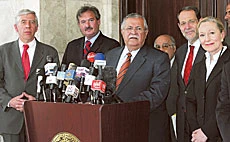
Talabani earlier met the EU delegation, which included the bloc’s foreign policy chief, Javier Solana, External Relations Commissioner Benita Ferrero-Waldner and Luxembourg’s foreign minister, Jean Asselborn. The EU trip came ahead of a June 22 international conference on Iraq that will be held in Brussels.
— Additional input from agencies