
The problem with Japanese motorcycles is that they leave you having to oil your own boots.”
Such was the received wisdom of leather-clad young motorcyclists of the 1960s gloomily watching the decline of a much-loved but impossibly unresponsive British motorcycle industry slowly die in front of them.
Hugely inventive in design and engineering but decades behind in ideas of customer service, reliability and choice, the British motorcycle industry was all but wiped out by the Japanese invasion. Yes, they were relatively simple machines and you could usually fix them yourself — and you frequently you had to.
With any invasion however, takeover is never total. Pockets of resistance survive to challenge the invaders. The British motorcycle enthusiast — for many years a reviled figure — stoutly defended the industry and preferred the character and history of low volume machines that were built rather than mass produced. Their stubbornness over the decades was rewarded.
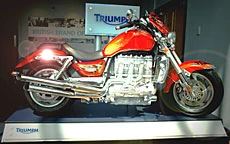
The gleaming 330 kg beast sitting in the foyer of the Triumph Motorcycle works in Hinkley in Leicestershire is awe-inspiring justification of that stubbornness.
The latest in 103 years of motorcycles and aimed squarely at penetrating the US market in direct competition with the Harley Davidson, the three cylinder 2,300 cc Rocket III roadster has the biggest engine of any production motorcycle in the world and all the style you could hope for. Seven hundred hours of engine run tests, 400,000 kilometers of road tests, 600 sets of tires and 60,000 liters of fuel used were used to prove the Rocket III as a reliable and very “rideable” machine.
It is a far cry indeed from the pe’s “Triumph Cycle Company” in 1886 or the first production Triumph motorcycle 1902 designed by Johanne Schulte with an engine fitted onto a bicycle frame.
Not the first to produce motorcycles in the UK — preceded by Excelsior in 1896 and Ariel in 1898, Norton, Royal Enfield, and Panther in 1901 — Triumph has survived the vicissitudes of world wars and economic collapse to dominate a niche market of motorcycle enthusiasts with a world beater.
Around the First World War Triumph developed the H model, later followed by the Model R and the popular 1920s model P with 500ccs. Despite the high production of motorcycles during these times, Triumph hit financial problems in 1936 and was sold to Jack Sangster.
He appointed Edward Turner as manager who managed to turn Triumph around and by upgrading the old designs and renaming them Tiger 70, Tiger 80 and Tiger 90 increased the sales tremendously.
Older models were updated and for the USA and the Thunderbird model was introduced in 1950 with a 650cc engine. Nine years later the famous Bonneville was launched from the development of the Tiger 110. The Bonneville nickname which became their most famous model name came from the Bonneville Salt Flats where a modified model was timed at 214 mph (345 kph) in 1956.
The Bonneville model was updated many times over the next years but it kept most of its original design. By 1972 over 250,000 models had been sold.
Between 1973 and 1983 the company struggled financially. Even a redesign of the Trident to a modern T160 Trident which had a remarkably good reputation on the market, did not help. The invasion of Japanese technology and designs brought the company to its knees and in 1983 Triumph went into liquidation.
Even when John Bloor, a plasterer turned construction magnate with a passion for biking, put up cash to save the company from the liquidator, it seemed that Triumph’s survival had more to do with his desire to preserve a piece of motorcycling heritage than any prospect of turning it into a profitable business.
Bloor eliminated that idea. “It was an opportunity to make money,” he told CNN in an interview in 2003, “But it was more difficult than I anticipated.” The collapse of the British motorcycle industry meant that the company was manufacturing its own parts because there were no local suppliers left. Triumph existed in little else but name.
“We purchased the name in January. We went to Japan in June. By September we had scrapped everything and started afresh. There was nothing here that we could use for the future.”
Starting again with just four staff, Bloor decided that Triumph could not compete in the mass production market. He concentrated on building a small, flexible and well-trained workforce that focused on quality engineering.
Bloor decided to develop a new range of Triumph Motorcycles in secret before launching them. The result, eight years and $160 million later, was a range of six roadsters which used many of the same components and styling features.
Reappearing as a real contender in 1990, Triumph’s sales grew steadily, until a devastating factory fire in 2002 shut down production for five months at a cost of $95 million, but under Bloor’s management Triumph was quickly back on track again. And in July 2003 the company launched its most challenging machine in its long history — the 2,300cc Rocket III.
Triumph’s faith in their customers has been rewarded. The first 300 Rocket IIIs were sold long before they left the production line.
Gone are the small geysers of oil from poorly seated joints, the joyous rattle of loosely machined parts and the greasy “leather boy” image of the biker — the average age of the Triumph customer is 42. These are serious minded people who know and love motorcycles and it was their long-term faith in the product that saw it through the lean years.
What is particularly appealing is the way the completely revamped range of motorcycles is still put together. “We’re automated, but not into mass production,” said Peter Clarke a fit looking enthusiast and guide who clearly enjoys taking fellow buffs round the ultra modern plant in the British Midlands. “We can react very quickly to customer demands and through the Triumph owners club, we get continuous feedback from riders.”
Eighty percent of production is exported to 40 markets world wide; currently, Saudi Arabia is not one of them.
In 1991 production of the revived Triumph marque was only eight units a day. “This year, we will be up to 200 units a day.” said Clarke, “We cater for a niche market and have a certain exclusivity.” In 2005, production will reach 32,000 units; by 2007/8, it should top 50,000. “Our customers are buying a machine that is far more than just a means of transport,” said Clarke. “They understand and feel about our motorcycles as passionately we do.”
The machines are put together by enthusiasts with reassuringly no-nonsense names and immaculate workplaces. The bikes are still hand built, the machined parts — down to four micron tolerances in critical places — assembled under a “neighborhood” cross checking system. Everyone double checks the work as it comes along the line apart from three quality checking stations on the lines. Quality control and reliability of the final product are absolute priorities.
The Triumph is very much alive and well. Soaked in history and striking chords of atavistic glory, the marque is attracting an increasing number of customers who seek quality, character and the knowledge that their machine has been built by people as obsessed with motorcycling as they are.
In the Hinkley factory on a day when the production lines were stopped for cleaning and benchmarking, you would expect everyone to be glad of a day off. Yet tucked away in quiet corners among the production lines earnest looking machinists and engine builders were working with deep concentration on their personal machines. Triumphs of course.
Comments: [email protected]