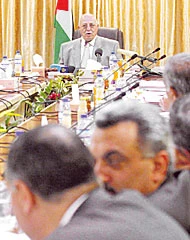
GAZA CITY, 15 June 2005 — Faced with increasing lawlessness in the occupied territories, Palestinian Prime Minister Ahmed Qorei yesterday said his Cabinet would go on strike if security forces failed to rein in armed groups.
“If this security chaos does not end, we will suspend our duties,” he told reporters in the Palestinian Authority headquarter in the West Bank town of Ramallah. “We are telling the heads of security services that there should be severe deterrence for all those who are tampering with security.”
Qorei said some members of the security services were responsible for some of the disturbances which they were meant to prevent. “The people are no longer prepared to tolerate these attacks, hundreds of which have been carried out by members of the security services,” he said.
“Any commander (of the security services) who is reluctant to hold them to account should leave the service along with the people themselves.”
Qorei’s remarks followed a surge of violence in Ramallah, previously less affected by strife that has plagued other towns in the occupied West Bank and Gaza Strip.
In the most recent of three shooting incidents in Ramallah in the past week, several members of the Palestinian security services took part in a gunfight between rival families in which two people were wounded.
They ultimately fired on police who intervened to stop the fight.
The Palestinian Authority headed by President Mahmoud Abbas is under heavy internal pressure to stop violence and crime, including shooting in the streets and a rising murder rate.
Abbas also faces demands from Washington and Israel to reform security services and enforce a cease-fire he agreed with Israel in February. Armed groups have signaled the truce was in jeopardy amid a flare-up of Israeli-Palestinian violence.
Abbas has made security reforms a top priority. He shuffled his security chiefs earlier this year and has repeatedly ordered them to halt chaos.
Palestinian officials say Israeli incursions and raids into Palestinian areas against fighters complicate their task to impose rule of law.
Palestinian Foreign Minister Nasser Al-Kidwa, a political ally of Abbas, said that stopping the work of the Cabinet over the internal strife was not appropriate. “The continuation of the work of the Cabinet is not a tactical matter,” he said, but added that the current security situation was “absolutely unacceptable”. “Certain strong measures have to be taken to regain a state of normalcy and to regain a sense of security for the Palestinians,” he said.
The Palestinian Authority, trying to send a message that it will be tough on crime, executed four convicted killers on Sunday in defiance of international calls to end capital punishment. They were the first executions by the Palestinian Authority since 2001.
But the violence continued yesterday when four Palestinians were killed in Gaza in a family feud.
In a separate development, new Israeli Chief of Staff Dan Halutz said the army would suspend its withdrawal from the Gaza Strip this summer to react to any firing from Palestinians during the pullout.
“If there is (Palestinian) fire, we will handle it,” Halutz told reporters. “I cannot see a situation where we can fight and evacuate (the settlers) simultaneously.” The hugely controversial operation to uproot the 8,000 Jewish settlers living in Gaza, the first time Israel has left occupied Palestinian territory, is due to begin in mid-August.
Halutz said that his men would deal sensitively with the settlers but warned that it would have zero tolerance toward any Israelis who attacked soldiers.
“There will not be a civil war because we are brothers. The settlers are our brothers and we will be extra-patient with them during the evacuation,” he said.
“Whoever fires at a soldier — whether an armed Palestinian or a settler — will meet the same fate,” he added.
Halutz said there were efforts to coordinate the pullout with the Palestinians but added that the pullout was not dependent on their agreement. “Coordinating the disengagement is not a condition. We will carry out the evacuation in any event,” he said.
— Additional input from agencies