
Forget about Bahrain, I have a better trip for you,” Mr. Khaled Almaeena, Arab News’ editor in chief told me. I was about to head off to Manama for a couple of days to test-drive the new Hummer H3.
When the boss started talking about the Riyadh and Eastern Province Chambers of Commerce and accompanying their delegation on an official trip, it sounded like I would be spending the next few days somewhere in the GCC attending business meetings and watching presentations with powerful executives that I had very little in common with. At that point, I wished I hadn’t come in to see the boss because, judging from prior experience, ‘official’ trips that involve delegations are, more often than not, spent indoors attending business meetings which, to me quite honestly, just induce sleep. “Everything was already set up. Why did I have to come in and bring up Bahrain?” I asked myself. The three days of ‘Hummering’ were disappearing before my ears as Mr. Khaled explained more. “You will be expected to write a story for the Economy page and for the Thursday Review,” he continued.
On the tip of my tongue was “I haven’t written anything for the economy page in more than two years; perhaps Ramkumar should go” when Mr. Khaled added, “Four days in Switzerland with a program put on by Switzerland Tourism.”
The first thing that came to my mind when the boss said, “Switzerland,” — was cheese. Now, Switzerland has always interested me, but in my mind it was where people went to study, to ski, or to open bank accounts. I imagined mountains, snow, and cows. Lots of cows. Being an urban kind of guy, Switzerland was one of those places I was planning on visiting — but later in life.
Suddenly those little chocolates with pictures of the Alps and Lake Geneva on wrappers came to mind. Swiss Army knives, and fondue followed shortly afterwards. This was beginning to sound like the trip of the year.
“Switzerland is probably the cleanest, and most organized place you will ever go to. People are polite and have very few hang-ups. The whole country just seems to flow. Everything is precise, has its purpose, its place and its time. It’s the land of Rolex,” my friend and colleague T. Cordeiro told me a couple of days before the trip. Cordeiro had studied in Lugano for three years and traveled extensively in Switzerland and neighboring countries.
Visits to the Swiss Consulate and Swiss Air office gave me a hint of what Cordeiro was talking about. Everyone was already expecting me as the Swiss Embassy had pre-arranged everything. My visa was ready in less than 24 hours as were my reservations and tickets all the way to Montreux. I couldn’t help but reflect on how smoothly everything went.
On the Swiss Air flight from Jeddah to Riyadh and then on to Zurich, I picked up the in-flight magazine to get ideas for the stories I was expected to write. The editors at Arab News probably expected a story that reads like this:
“The landscape in Switzerland includes plenty that can also be found in other countries around the world. There are mountains, glaciers, lakes, rivers, narrow valleys and broad plateaus. The unusual thing about this geographical diversity and the temperature extremes that go with it is its concentration within a small area in a single country.
Arctic conditions abound at 11,000 feet and a lush Mediterranean environment exists less than 60 miles away — in a country that takes just three to four hours to cross from west to east by road or rail — a mere 220 miles at its widest point. From north to south, Switzerland is 160 miles long. In this direction, nature takes the winding roads, railways and homes, higher and higher up into the mountains.”
Now Switzerland’s natural beauty is recognized the world over, but what I was about to discover over the next three days touring the Crans-Montana Matterhorn Region, Geneva and the surrounding areas, is that there is more to Switzerland than just its mountains, lakes and waterfalls.
“Take a moment and just breathe the air. Take a good deep breath, you’ll feel the difference,” Cordeiro told me two days before the trip. “Also pay attention to the traffic. There are sensors about 100 meters before an intersection that turn the lights green for you if there are no other cars approaching,” he explained. Switzerland was beginning to sound too good to be true. “My article is supposed to be balanced. Can you tell me about something that you didn’t like in Switzerland?”, I had to ask Cordeiro. He answered, “Well, I don’t remember any of the hotels ever having a bidet which I imagine might be disturbing for visitors from the Middle East.”
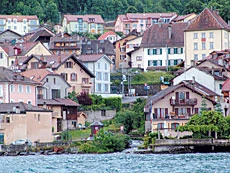
So here I am at the Montreux Palace Hotel — room 416 — on my balcony overlooking Lake Geneva. It’s very quiet. There are swans swimming in the lake; the sun is setting, casting a warm glow over the snow-capped mountains, which seem to rise straight out of the lake. It is all very picturesque really — exactly as Cordeiro described it.
I checked the bathroom and discovered that he was also right about the bidet. There was a bathtub and a separate standing shower next to it, but no bidet.
On the street — four floors below — there is no mad rush by drivers to reach the crosswalk before the pedestrians. There are no potholes nor are there any garbage dumpsters blocking traffic like at home. I was beginning to get the sense that the Swiss, from a young age, developed their own appreciation for the beauty of their country and understood that the responsibility for its preservation for future generations fell upon them.
While walking around, members of the delegation I was with commented on how most people who walked by were courteous and either nodded, or smiled a polite greeting. We were a group of over 12 people, mostly Saudis — some with beards — wearing red nametags with names such Mohammed and Abdul Rahman printed on them. It was obvious that we were Saudi — but no one seemed to care.
I couldn’t help but smile at thinking that had we been passing through the immigration counter at New York’s JFK airport, we might have been red-flagged for a ‘special’ interview. But here in Switzerland no one seemed so concerned with where we were from, only who we were. Everytime I told someone I was Saudi, I seemed to get the VIP treatment. It made me want to raise my own red flag — the Swiss one.
I was beginning to understand why Switzerland had most of the top-rated hotel and hospitality schools and colleges. It almost seemed as if the Swiss knew only how to be polite and courteous. It was their way of doing things and it came naturally.
Earlier in the day our delegation was two hours late for a presentation in Sierre. Over the past couple of days the Swiss had demonstrated that they — above all things — are punctual. It’s the land of Rolex after all. Judging from how politely flustered our Swiss host Sommaruga was becoming while trying to rush us away from the Crans-Montana Golf Course, I got the sense that, by being late, we were committing a very grave offense.
But true to the Swiss way, Mr. Rolf Wilk, professor at the Ecole de Tourisme de Sierre — whose team we had kept waiting — still had smiles, greetings, hot beverages and gifts for us all — even though we were two hours late. While the delegates were with Wilk, I decided to walk around Sierre on foot to take some pictures of the small mountain town. After walking in the sun for 30 minutes, I sat down for an espresso on the patio of a small café. Looking around, I tried to get a sense of what it would be like to grow up here when four young boys rolled down the mountainside road on their bicycles. They sat down, ordered and started working on what looked like their studies — and they seemed happy doing that. “What a life,” I thought to myself. A short while later, a teenage boy and girl drove up to a snowmobile and scooter shop on motorized bicycles and went in. Moments later, they were out of the store heading up the mountain towards the forest. I decided that this was the right moment to take in that meaningful breath of air I had promised Cordeiro I would take.
It was about 16 degrees Celsius, the sun was shining and I had a bit of time to walk up the narrow streets that snaked up the mountainside. Each house seemed to mesh with the one next to it. It was as if all the neighbors got together and worked out a plan to decorate each house and each road collectively. It all matched. There were potted plants on every windowsill and milk bottles at some doorsteps. In the surrounding hills, there were indeed lots of cows. I half-expected someone to trot by on a horse at any moment.
All this clean Swiss mountain air and natural beauty, must have a positive effect on the people who live there. But even more impressive to me was how each person is left to do what he or she wants so long as it does not — in any way — infringe on another person’s right to live an equally free, unmolested life. One teacher at College du Leman in Versoix — when asked about Switzerland’s liberal attitude towards drugs, and how it affected the student body — demonstrated the Swiss attitude toward individual liberty by explaining the drug laws for this canton (the local district).
He said: “At College du Leman, drugs are strictly prohibited, but in Switzerland, the laws vary from one area to another. In this canton, it is permissible for someone to possess — for personal use — a small quantity of marijuana for example, but it is a serious offense to buy it or sell it.”
Leading a disciplined life in a country that values a person’s individual liberty, where the utmost importance is placed on being respectful, considerate, and hospitable and where everyone does their part to contribute to the greater good is what really struck me as being the most impressive aspect of Switzerland.
It has been said that beauty is only skin deep. In this case I disagree. The mountains, lakes and forests of Switzerland are truly enchanting, but equally impressive is the way the Swiss people live, and work together without compromise to hold on to a tradition of excellence and professionalism recognized the world over. That, you cannot reduce to a picture on a postcard.