TEHRAN, 19 June 2005 — Iran will hold the first runoff presidential election in its history between political veteran Ali Akbar Hashemi Rafsanjani and Tehran’s hard-line mayor.
The contest on Friday offers distinct choices. Rafsanjani, 70, is a moderate who served as president from 1989-97. His rival Mahmoud Ahmadinejad, 49, is untested as a national political figure and has the backing of Iran’s ruling clerics and their military guardians.
With 29.3 million votes cast, Rafsanjani took 6.1 million or 21 percent of the vote. Ahmadinejad took 5.7 million votes or 19.48 percent. Former Parliament speaker Mahdi Karroubi lost the No. 2 spot by a whisper with 5.6 million votes or 19.3 percent of the vote.
Friday’s voting turnout of 62.7 percent was a resounding rejection of a youth-led boycott — with lines of voters forcing polling to continue four hours overtime. Iran’s hard-line leaders said US President George W. Bush helped fuel the turnout by sharply criticizing the elections as undemocratic and angering many Iranians.
Ahmadinejad, who surprised analysts with his strong performance, reportedly had the support of Iran’s most hard-line factions, including the Revolutionary Guards.
Karroubi, who was popular in rural areas, accused Revolutionary Guards and their civilian vigilante wings of intimidating voters and appealed for an investigation.
“There has been bizarre interference. Money has changed hands,” the centrist-reformist cleric and former Parliament speaker told reporters in an unprecedented allegation. “They can go and file a lawsuit against me, but I will give all the names of the people in power in my defense,” he said defiantly.
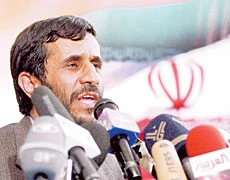
Ahmadinejad immediately hit back. “Those who the people do not choose in an election always have the tendency to complain,” Ahmadinejad told a news conference.
It was such a shock result, even his own campaigners had not built the podium for Ahmadinejad to announce his success.
But Karroubi insisted Ahmadinejad’s showing was highly suspicious and appealed to supreme leader Ayatollah Ali Khamenei to “appoint an honest and trusted committee” to probe the Guardians Council — an unelected political watchdog — the Interior Ministry, the Revolutionary Guards and the Basij militia.
The reformist Mostafa Moin, a former culture minister, had been seen as a strong possibility to enter the second round against Rafsanjani. But yesterday he fell to the bottom of the heap along with Bagher Qalibaf, a former head of the national police and another hopeful for the second spot.
“Despite the many warnings by the president and the Interior Ministry and also political parties, we see that an organized movement has targeted the health of this election,” Moin said in a statement. “With this action our new-born democracy is in danger,” he added, without making specific allegations.
Ahmadinejad’s performance surprised many as opinion polls had placed him well down the list of seven candidates. But his reputation as a man of the people fiercely loyal to Iran’s system of clerical rule appeared to have won him strong support in rural areas and among the urban poor, for whom unemployment and the cost of living are the main concerns.
Whoever wins, unelected supreme leader Ayatollah Ali Khamenei will keep the last word on state affairs and hard-liners will retain key levers of power such as security and the courts. Reformists, stunned by the poor showing of their favorite Moin, debated whether to throw their weight behind Rafsanjani in the second round.