JEDDAH, 19 June 2005 — Murders, robberies and assaults in Jeddah have been making headlines for the past few months. The latest news of police raids and the huge number of overstayers involved in organized crime may mislead people about the real conditions in the city. A contradiction to these stories can be found in the city’s several markets. Most shops in these markets are left wide open, without guards, during prayer times; however, no thefts or illegal acts have ever occurred.
This leaving of shops open is normal in a number of low-budget markets in Jeddah such as Al-Bawadi, Mahmoud Saeed, the Syrian Souq and others.
It all started in Al-Balad, the oldest part of Jeddah. It was and still is the heart of the city. A number of famous souqs — local markets — are there. Souq Al-Alawi, a long narrow pedestrian street with tiny shops along it and at the corners, is one of the neighborhood’s famous souqs. Though the items being sold differ from traditional to modern, time seems to have stood still, not only because of the faded, worn-out buildings but also because of another vital and intangible factor — personal integrity.
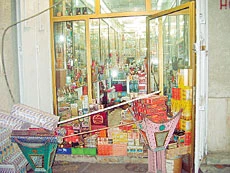
What I mean becomes evident at prayer times; shopkeepers usually go to pray and leave their shops unlocked and unprotected except for a piece of cloth across the entrance. What typically happens is that shops are virtually open and customers are waiting patiently for the shopkeepers to return from the mosque. There is no question of stealing or even going into the shops during prayer times. What might seem bizarre and unusual is normal and usual in the area.
Arab News witnessed several shopkeepers leaving their shops covered but untended while going to Maghreb prayer. One eye-catcher was an old man who was leaving his tiny hardware store. He simply fixed two slender sticks on two stands, leaving the door wide open and a dozen full boxes with different kinds of goods on the steps in front the store.
Arab News approached Shamsudin Al-Hassan, the old man, and asked him why he left the shop open. He replied calmly: “Allah is guarding the shop.”
When we asked him if he had ever had a robbery or if he had taken any precautions to avoid thieves, he shook his head and answered smilingly: “I opened this shop 55 years ago. I have never ever locked it during prayer times and no one has ever stolen anything. I leave the shop open so people passing by can see what is for sale and as a good Muslim, I rely on God to protect my shop and I protect it by reciting verses from the Holy Qur’an.”
He continued, “There was a fire in the building — where the shop is located — 25 years ago and my shop was the only part that wasn’t burned!”
The gray-haired Shamsudin Al-Hassan headed to the mosque at ease, knowing that his store is guarded by God.
Strolling in the Souq Al-Alawi during prayer time, one comes upon tens of other shops just like Al-Hassan’s. A textile store left wide open with a piece of cloth casually hanging on the door showing all the colorful textiles inside, a luggage shop whose owner used the very same suitcases he was selling to build an obstacle in the doorway — and the list goes on. The same answer is given by all the shopkeepers: “God is watching.”
The tempting sight of unclosed, unguarded shops did not attract shoplifters. Arab News observed distinctly the movements of the crowd in the narrow alleys. It was clear that anyone could easily and without being detected pick up anything from the shops but no one did. Women sitting beside the shops were patiently waiting with their children; men were hurrying to go to the nearby mosque and non-Muslims were standing there, more like guards than customers.
When a man passing by was asked what kept people out of the shops, he pointed to the sky. A poor-looking woman sitting beside the shop frowned when I asked the same question. Despite all the talk of Jeddah turning into an unsafe, dangerous city, there remains hope which can still be found in the heart of the city.