RIYADH, 21 June 2005 — The United States has no plan to impose democracy on Middle Eastern countries, US Secretary of State Condoleezza Rice said early today. “It’s up to the countries in the region to implement democracy. Our role is just to speed up the democratization process,” she said.
Speaking to reporters here, Rice also said she had raised the issue of three jailed Saudi reformists during her meeting with Foreign Minister Prince Saud Al-Faisal. “I did raise the issue of reformists tonight with the foreign minister and we continue to follow the progress of the case.” She said she believed that petitioning the government should not be a crime.
Prince Saud said the three — Ali Al-Demaini, Abdullah Al-Hamed and Matruk Al-Faleh — were jailed for violating the country’s laws, adding that the government would not interfere in judicial matters.
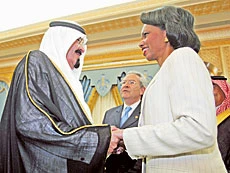
Earlier, Crown Prince Abdullah and Rice held talks on major regional and international issues, including Palestine and Iraq, and ways of strengthening bilateral ties.
Prince Abdullah later hosted a dinner in honor of Rice and her delegation.
Addressing a joint press conference with Rice, Prince Saud described the talks between Prince Abdullah and the secretary of state as “fruitful.” He emphasized the strong relations between Saudi Arabia and the United States. He said the Kingdom was ready to sign WTO agreement with Washington. The two countries have set up a special committee to strengthen their ties.
Rice commended Prince Abdullah’s efforts to accelerate economic and political reforms in the country. She emphasized the cooperation between the two countries in combating terrorism. She described the detainees in Guantanamo camp as dangerous people. “The US and Saudi Arabia share a common problem here, which is, how to deal with terrorism.”
Earlier in a speech in Cairo, Rice praised the three Saudi reformists as “brave citizens.” She described recent municipal elections in the Kingdom as “first steps toward openness.”
The three reformists were sentenced to between six and nine years in prison in May on charges of demanding a constitutional monarchy. They were among a dozen people arrested in March 2004. The others were released after pledging to no longer lobby publicly for reform.
The three were accused of “using Western terminology” in formulating their demands. They also questioned the king’s role as head of the judiciary.
Rice also criticized emergency law, arbitrary justice and violence against peaceful demonstrators in Egypt and called on the Egyptian government to “put its faith” in the people. She emphasized the strategic relations between the US and Egypt.
In a major policy speech at the American University in Cairo, Rice said democracy should not be imposed from outside. “Every country has its own history, customs and special nature. As a result it is not possible to impose a particular model of democracy on all peoples of the world,” she said. “There is no plan to impose sanctions on countries that oppose democratic reforms,” she clarified.
— Additional input from agencies