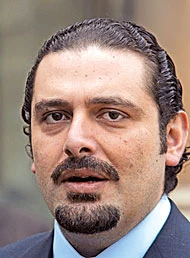
BEIRUT, 21 June 2005 — The leader of Lebanon’s victorious opposition alliance, Saad Hariri, said yesterday it was too early to talk of becoming prime minister, insisting he first wanted to hold talks with his defeated rivals.
“We are trying to get a more broad alliance in discussion with other parties,” Saad told a Beirut press conference. “Once we achieve that, we will discuss about the prime ministership.”
Saad ruled out any precipitate move to unseat under-fire pro-Syrian President Emile Lahoud, who has more than two years in office after a controversial Damascus-inspired extension was approved last September.
“This is an issue that is quite sensitive in Lebanon,” he said. “We will move with the sensitivity that it needs.”
Saad rejected suggestions his alliance had no program comparable with glossy 47-page policy document put out by one of his main election rivals — Christian firebrand Michel Aoun. “We have a program, we will issue it within a week,” he said.
The 35-year-old businessman, who was catapulted into politics by the February assassination of his five-time premier father Rafik, made frequent references to his legacy and attributed his election win to his reputation.
“We are following in the footsteps of my father,” Hariri said, speaking in front of a huge portrait of his late father. “I owe my father everything. This election was about my father. I think people believe in my father. I am here to continue what he started in economic reforms and fighting corruption.”
He said his father’s principal policy had been to remove the impediments to economic growth, which is running two percentage points below inflation so far this year, according to the central bank.
“His political and economic program is to have a legal system that has everything that we need to have growth. In order to have growth we need to change a lot of laws in Parliament. We will continue what my father has started,” he said.
During the four-stage election campaign, which culminated on Sunday, Saad repeatedly accused his pro-Syrian opponents of having blocked his father’s attempts at market reforms during his five terms in office between 1994 and 2004.
“Everything he couldn’t do we will find a way to do because we have a free country,” he said, referring to Syria’s ending of a 29-year troop presence in April.
“Unfortunately we paid a very high price to get our freedom,” he said, referring to his father’s murder in a massive bomb blast on the Beirut seafront two months earlier.
Saad said he wanted to end widespread skepticism in Lebanon about the possibilities of real change. “We have got to show people that we are not only here to talk but to work with the program. We want change, we want to see new faces, we don’t want a program that gets stuck in its wheels.”
US ambassador Jeffrey Feltman had made the same point earlier even as he hailed Lebanon’s first elections free of Syrian influence as a “milestone.” “The international community hopes to see credible figures to promote reform, we hope to see this skepticism disappear,” he said.