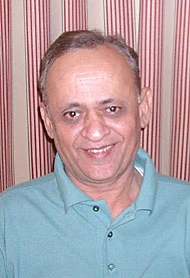
JEDDAH, 24 June 2005 — A senior Indian political journalist, Zafar Agha, feels that the worst is over for Indian Muslims but says that the community’s “mullah-driven leadership can lead them nowhere.” In an interview with Arab News, he said: “It is time for them to have a modern and forward-looking leadership.”
Agha, who is here in the Kingdom at the invitation of Jeddah’s Urdu Academy, was among the very few journalists who predicted the fall of the Bharatiya Janata Party-led National Democratic Alliance in the May 2004 elections. He said Indian Muslims had suffered all kinds of discrimination throughout the 1990s and especially during the period of BJP-NDA rule.
“Their places of worship were demolished; they became the target of the worst kind of mass communal hysteria coupled with state-sponsored violence in Gujarat... But the May 2004 parliamentary election results have transformed the political and social stock of the community. Across the country, Indian Muslims voted against the BJP and forced it out of power. Somehow the message has gone round that they are the kingmakers. No party can rule without their support.”
According to him, there is a sort of competition among Indian political parties of all hues to woo the Muslims. “The five percent job quota for them in Andhra Pradesh and L.K. Advani’s reference to Muhammad Ali Jinnah’s secularism is the proof that right from the Congress down to the BJP, everyone is seeking Muslim support in India.”
Agha became a journalist in 1980. Those were the days when there was no money in the profession. But, as he says, “We belonged to the generation that had turned anti-establishment because of the 1975 Emergency.” His career began to take off from 1986 onward. “That was the year when the Babri Masjid was unlocked. Uttar Pradesh was the scene of massive communal riots.”
Since then he has reported all the major riots such as Meerut, Malliana and others. His bold reporting and his open support for V.P. Singh in that period made Indian Today Editor in Chief Arun Poorie offer him a job in 1990. “I came very close to V.P. Singh during the Bofors controversy, traveled all over the country with him and reported Rajiv Gandhi’s decline in the late 1980s.”
At India Today, where he was in charge of political affairs, he covered major events such as the Babri Masjid demolition, Rajiv Gandhi’s assassination and the rise and fall of P.V. Narasimha Rao. “My personal impression of the demolition of Babri Masjid that appeared in India Today was one of my best pieces and I still value it.” In 1997 when India Today leaned editorially toward the BJP, Zafar Agha resigned and later went to work for Tarun Tejpal’s Tehelka.com.
We see a lot of Muslims in mainstream journalism these days, especially in the electronic media. What does he think led to this turnaround? “Well, when I joined the profession, there were only two prominent Muslims in it — M.J. Akbar and Seema Mustafa. Seema had joined the Patriot group just a few months before I did. We can claim that the three of us inspired a lot of Muslim boys and girls to take to journalism. Now there are scores of Muslim boys and girls in mainstream Indian journalism, both print and electronic, and they are doing very well for themselves. I am happy to have seen this change.”
On how the current government is faring and will it complete its full term, Zafar Agha said: “The Congress-led United Progressive Alliance government has great potential and will do wonders if it sticks to its common minimum program and avoids blind economic reforms that the NDA government pursued before being voted out. At the moment, there is no alternative — TINA factor — to the UPA as the BJP is in a mess. The Manmohan Singh government seems secure and should complete its full term unless it blunders mid-way and messes up its act.”
Zafar Agha is soon planning to launch an English publication and is seeking investment from non-resident Indians (NRIs). “The traditional Indian media is now too commerce-oriented. Both the print and electronic Indian media seem to have given up their social commitment after Indians got connected to the global economy. As a result, readers feel starved of papers and magazines with genuine content. There is too much gloss in the Indian media now but there is very little content. So there is a big market for that kind of media venture. I am working on an English magazine project but have very little resources of my own to invest.”
He is looking for two kinds of investments. “One, the Tehelka newspaper kind in which some donors contributed 100,000 Indian rupees to become permanent stockholders. This method generates core money to launch the project and then things follow. The second idea is to have a partnership kind of venture with big investors.”